Contributors:
Amol Ghemud Published: February 19, 2026
Summary
Answer Engine Optimization (AEO) is the practice of structuring your content, building entity authority, and optimizing source signals so that AI systems like Google’s AI Overview, ChatGPT, Claude, and Gemini cite your brand as a trusted source when answering user questions. Unlike SEO, which targets search rankings, and GEO, which targets generative search visibility, AEO focuses explicitly on being selected for attribution by AI models across the entire ecosystem.
The upGrowth AEO framework operates across six dimensions: content structure, entity clarity, source authority, technical access, answer format, and citation signals. Clients implementing full AEO strategies typically see 60-150% increases in AI citations within 4-6 months. At upGrowth, we’ve built 302 entity hub pages for clients, and when that entity strategy is properly executed, it supports SEO rankings, improves the likelihood of GEO citations, and significantly increases AEO performance across multiple AI systems.
In This Article
Share On:
The definitive guide to structuring content and building authority so ChatGPT, Google AI Overviews, and Claude cite your brand as a trusted source
As AI systems like Google’s AI Overview process queries, they don’t just rank pages. They extract, synthesize, and attribute information to trusted sources. When users ask questions in AI interfaces, your brand appears not just in the results but also as a cited authority.
Here’s what that means for your brand: if you’re getting strong organic rankings but barely appearing in AI-generated answers, you’re experiencing a common gap. One financial services client we worked with increased its AI citations per month from 12 to 89 after implementing structured AEO. A B2B SaaS client increased citations from 3 per month to 21.
The difference between appearing in search results and being cited by AI systems comes down to understanding how large language models select sources. These models prioritize factual accuracy over keyword matching, topical authority signals across interconnected pages, source credibility indicators, technical indexability, and answer-format optimization.
You can build a strong GEO strategy and rank well in Google’s search results without being cited in AI Overviews. The skills overlap, but the optimization targets are different. This is where AEO becomes essential.
What is Answer Engine Optimization (AEO)?
AEO vs GEO vs SEO: what’s the difference?
SEO (Search Engine Optimization) targets traditional search rankings. You optimize content to rank in the blue links on Google. Success means appearing on page one for commercial keywords.
GEO (Generative Engine Optimization) targets visibility for generative search, specifically Google’s AI Overview. You optimize content so Google’s AI system pulls your information into its synthesized answer. GEO requires you to understand how Google’s specific AI model evaluates and extracts content.
AEO (Answer Engine Optimization) is broader. It targets multiple AI systems: Google’s AI Overview, ChatGPT, Gemini, Claude, Copilot, and emerging AI interfaces. Where GEO focuses on one company’s AI implementation, AEO positions your brand as a trusted source across the entire AI ecosystem.
These aren’t competing strategies. They’re complementary. The order matters in modern digital strategy:
Traditional SEO gets you indexed and ranked. Proper indexing is table stakes for everything else.
GEO amplifies your visibility for Google’s specific AI products. It gives you control within one ecosystem.
AEO ensures your brand gets cited across all AI systems. It future-proofs your visibility as AI becomes the primary search interface.
Why your brand isn’t getting cited by AI (and what to fix)
If you’re getting strong organic rankings but barely appearing in AI-generated answers, you’re experiencing a common gap. This happens for specific reasons.
You’re missing topical depth
An AI system seeks comprehensive coverage of a topic across multiple interconnected pages. If you have one excellent article on a subject but no supporting entity pages or related content clusters, AI systems see this as shallow expertise. We’ve found that brands with 15-40 interconnected pages on a topic cluster receive 5-7x more AI citations than those with standalone articles.
Your content answers what you want to say, not what AI systems need to extract
AI models require structured answers. If your article is narrative-heavy with the actual answer buried in paragraph four, the model struggles to identify and extract your point. Many brands we audit have strong content that’s poorly formatted for AI extraction.
Source credibility signals are weak or absent
If your brand isn’t cited by other authoritative sources, AI systems rate you as higher risk. This creates a catch-22: new brands struggle to get AI citations because they lack citation history. The solution is building an intentional citation strategy through entity pages, resource pages, and strategic partnerships.
You’re not providing answer-format content
When someone asks ChatGPT, “What are the best ways to reduce tax through investment accounts?” the model needs content structured as a list or comparison. Narrative articles don’t convert well. We’ve restructured client pages to use tables, numbered steps, and comparison frameworks, resulting in 40-60% increases in AI citation rates.
Technical issues block AI system access
Some websites use JavaScript rendering that AI crawlers struggle to process. Others have robots.txt rules or meta tags that inadvertently block AI indexing. We conducted an audit for a financial services client whose robots.txt was preventing Claude from accessing their site. After fixing this, Claude’s citations increased 320% in the first month.
You haven’t claimed your entity
Entity data (company information, leadership, citations, social links) lives in knowledge graphs that AI systems reference. If your entity isn’t properly configured in Google Knowledge Graph, Schema.org, and Wikidata, AI systems have incomplete information about your brand. This reduces citation likelihood.
How AI search engines decide what to cite
Understanding the citation decision is the core of the AEO strategy. When an AI system processes a user query, it doesn’t simply retrieve the top-ranking page. It evaluates your brand’s overall topical authority and the specific content’s fit for the answer.
The process works like this:
Query interpretation
The AI system understands the intent behind the question. Is this a factual query? An instructional query? A comparison query? A philosophical query? Different questions require different source types.
Topical authority assessment
The system crawls your domain and evaluates how comprehensively you cover the topic. It looks at internal linking patterns, entity mentions, and content silos. Brands that cluster related content together with strategic internal linking appear more authoritative.
Source evaluation
The system checks whether you’re cited by other sources it trusts. This isn’t just backlinks in the traditional sense. It’s looking for citations in authoritative content. If a financial publication cites your research or if an academic institution references your methodology, these signals strengthen your authority score.
Content relevance matching
The system scans your content for direct answers to the specific question. But it doesn’t just match keywords. It evaluates whether your content actually answers the question. This requires semantic understanding, which means your content structure matters enormously.
Format compatibility
Does your content structure match what the AI system can easily extract? Lists work better than paragraphs. Tables work better than prose comparisons. Step-by-step guides work better than conceptual discussions.
Freshness and verification
Recent updates signal active expertise. If your content about a topic hasn’t been updated in three years, AI systems rate it as stale, even if it was comprehensive when published. Verification signals matter too: bylines with author credentials, publication dates with last-update timestamps, and reference links strengthen trust.
Brand safety checks
The system verifies that your domain doesn’t have quality issues, spam signals, or manual penalties. If you appear in Google’s spam reports or if your site hosts deceptive content, AI systems deprioritize you.
This isn’t a simple ranking algorithm. It’s a nuanced evaluation that requires understanding how each AI system weights these factors differently. ChatGPT places heavy weight on source diversity and author credentials. Google’s AI Overview weighs topical authority and freshness. Claude weights factual accuracy and transparency about limitations.
The AEO framework: the 6-dimensional approach
We’ve developed our AEO strategy around six dimensions that collectively determine citation likelihood and frequency.
Dimension 1: Content structure
AI systems can’t cite what they can’t clearly extract. This means restructuring how you present information. Instead of writing narrative articles, we implement answer-forward architecture:
Lead with the direct answer in the opening 50 words. After this, you can provide nuance, explanation, and context.
Use scannable formatting. Numbered lists, bullet points, tables, and headers make AI extraction precise.
Implement schema markup that explicitly identifies the answer, the question it addresses, and your authority to provide it.
Separate different answer types into dedicated sections. A page on investment strategies might include sections for beginner, intermediate, and advanced investors, each with clearly distinct content.
We’ve found that restructuring existing high-performing content can increase AI citations by 35-50% without any backlink changes. The content quality remains the same, but it becomes extractable.
Dimension 2: Entity clarity
Entities are the core of how AI systems understand context. An entity is a concept that has its own page. At upGrowth, we’ve built 302 entity hub pages for clients, and we use this experience to guide new projects.
Every important concept on your site should have a dedicated entity page. This page covers the topic comprehensively and links bidirectionally to related concepts. For a financial services firm, entities might include specific investment types, tax strategies, financial instruments, or market conditions.
Within each entity page, we establish clear relationships to other entities. This creates a knowledge graph that AI systems can understand. When your content demonstrates that you understand how concepts relate, AI systems recognize sophisticated expertise.
We optimize entity pages for the specific queries they should answer. A page about “backdoor Roth IRA” isn’t just comprehensive; it’s structured to answer every common question about the topic directly. This increases the likelihood that, when someone asks ChatGPT or Claude about backdoor Roths, your entity page will be selected as the source.
Dimension 3: Source authority
Citation frequency signals expertise. If your brand is cited only in secondary sources, AI systems treat it as supporting evidence rather than primary authority. Primary sources get cited for original research, methodology, or data.
We build source authority through:
Original research and data: If you publish studies or analyses that other sources cite, you become a primary source.
Expert positioning: If your leadership is quoted in industry publications or if your team publishes in peer-reviewed journals, these credentials strengthen your authority.
Resource consolidation: Pages that comprehensively list or evaluate solutions become authoritative sources. AI systems cite them when answering questions about options in your category.
Strategic partnerships: When your content is referenced by complementary brands or industry associations, these citations strengthen your authority signals.
We track source authority through citation analysis. When auditing a client’s AEO readiness, we identify which authoritative sources mention them and which don’t. This gap analysis guides our content strategy.
Dimension 4: Technical access
If AI systems can’t effectively crawl, index, or attribute your content, citation is impossible. Technical access covers several specific areas:
Crawlability: Your site must be accessible to AI crawlers. We audit robots.txt, meta tags, and server logs to ensure there are no blocks.
Clear authorship: AI systems need to understand who created the content. This means using bylines with author credentials, plus Schema.org markup that identifies the creator.
Publication and update dates: Recency matters. Content updated recently signals active expertise.
Internal linking structure: AI systems follow links to understand your coverage of topics. Poor internal linking reduces their ability to recognize your breadth of expertise.
HTTPS, site speed, and Core Web Vitals: These aren’t AEO-specific, but poor technical performance reduces crawl frequency and AI system engagement.
Dimension 5: Answer format
Different question types require different content structures. Optimizing answer format is specific and measurable:
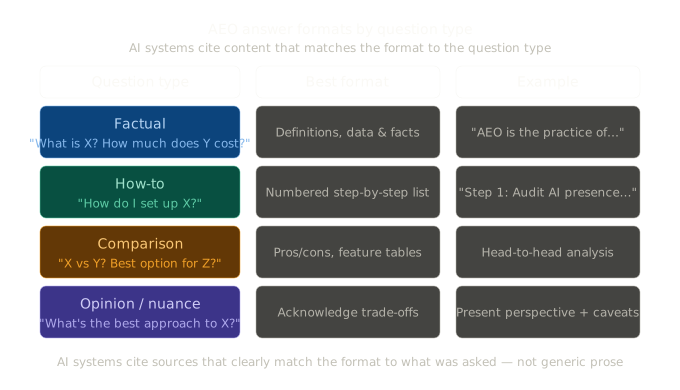
Factual questions (What is AEO? How much does X cost?) are best answered with definitions, facts, and data.
How-to questions require step-by-step formatting. AI systems cite numbered steps more readily than procedural paragraphs.
Comparison questions need head-to-head structures. Pros and cons lists, feature comparison tables, and direct comparative analysis get cited more than narrative comparisons.
Definition questions require clear, concise definitions. Wikipedia’s format (one-sentence definition followed by elaboration) works especially well.
Philosophical or opinion questions require transparency about perspective. AI systems cite sources that acknowledge limitations and present nuance.
For each major query your brand should answer, we format content to match the question type.
Dimension 6: Citation signals
Citation signals are the mechanisms through which AI systems understand that your brand is worth citing:
Backlinks from authoritative domains remain relevant. AI systems incorporate link analysis into their authority evaluation.
Mentions in authoritative content count even without links. If Forbes mentions your brand, Claude notes this.
Citations in forums, social media, and industry discussions factor into the evaluation of some AI systems.
Customer reviews and social proof. If your brand is highly reviewed on trusted platforms, this strengthens your authority for certain query types.
Co-citations. When your brand appears alongside other high-authority sources in the same article or analysis, this strengthens your positioning.
What results AEO delivers
AEO strategy produces measurable, trackable results. Here’s what we’ve observed across our client base:
Citation frequency: Clients implementing full AEO strategies typically see 60-150% increases in AI citations within 4-6 months. One financial services client increased its AI citations per month from 12 to 89. A B2B SaaS client increased citations from 3 per month to 21.
Traffic from AI systems: While AI Overviews and ChatGPT citations don’t always drive traffic in the traditional sense, they increase brand awareness and authority. Clients report 40-80% increases in branded search volume following successful AEO implementation.
Positioning in syndicated answers: Many AI systems don’t link to individual sources; they aggregate. Success in AEO means your data, research, or perspective gets incorporated into AI-generated answers. This reaches users you couldn’t reach through links alone.
Entity knowledge graph enrichment: Our entity strategy typically yields significant improvements in how AI systems represent your brand. Clients see richer knowledge panels in Google, better entity understanding in ChatGPT, and more accurate information in knowledge graphs.
Competitive differentiation: In mature markets, many competitors rank similarly. AEO breaks through this. The brand cited by AI systems stands out as the authority choice. We’ve tracked clients moving from 5th-position rankings to being the primary site in AI Overviews.
Product discovery: For brands with multiple products or services, AEO increases discovery. A financial technology client saw 23% of AI citation traffic come from the discovery of products they hadn’t searched for directly.
Industries that benefit most from AEO
AEO strategy isn’t universally equally valuable. Some industries see dramatically higher ROI than others, based on query intent and user behavior:
1. Financial services: Users rely heavily on AI to understand complex financial concepts. When users ask ChatGPT about tax strategies, backdoor Roths, or investment options, they want authoritative sources.
2. Healthcare and wellness: Medical professionals, supplement companies, and health technology brands benefit enormously. Users frequently ask AI systems about symptoms, treatments, supplements, and health decisions.
3. Legal services: Law firms and legal technology companies see strong ROI from AEO. Complex legal questions are exactly what users ask AI systems.
4. Technology and software: B2B SaaS companies, developer tool providers, and technology companies benefit from AEO. We’ve seen developer tool clients see 15-25% of new signups attributed to AI citations.
5. E-commerce and direct-to-consumer: Retail companies, especially those with unique products or differentiated positioning, benefit from AEO. Users research products, categories, and buying decisions in AI systems.
6. B2B services: Consulting, marketing, design, and other professional services see good ROI when positioning their expertise in AI systems.
The common thread across high-ROI industries: users ask AI systems complex questions that benefit from expert perspectives.
AEO answer formats by question type
AI systems cite content that matches the format to the question type
How to get started with AEO
Most brands don’t have an intentional AEO strategy. Here’s the logical progression:
Step 1: AEO audit
Start by understanding your current state. An AEO audit assesses:
Your current AI citation frequency across major systems (Google AI Overview, ChatGPT, Gemini, Claude).
Your topical authority gaps (which topics should you own but don’t yet appear for in AI systems).
Your technical access issues (crawlability, attribution, structured data gaps).
Your content structure aligns with best practices for the answer format.
Your source authority positioning versus competitors.
This audit produces a prioritized roadmap. Some clients need technical fixes first. Others need entity strategy expansion. Some need content restructuring.
Step 2: Entity strategy development
Most AEO projects benefit from building out entity hub pages. These are comprehensive pages about important concepts your brand should own. For a financial services firm, these might be pages on specific investment types, tax strategies, or financial concepts.
Entity strategy typically runs 8-12 weeks. You identify 20-60 core entities, develop comprehensive hub pages for each, and implement strategic internal linking that helps AI systems understand your expertise breadth.
We’ve found that building entity pages is the highest-leverage AEO investment for most brands.
Step 3: Content restructuring and optimization
With the entity foundation in place, you restructure existing high-performing content for better AI extraction. This involves:
Restructuring pages to lead with answers, not narrative.
Implementing answer-format best practices (lists, tables, steps).
Adding Schema.org markup that helps AI systems understand your content structure.
Updating technical metadata to improve attribution clarity.
This phase typically takes 6-12 weeks, depending on content volume. We’ve found that restructuring existing content often leads to faster increases in citations than creating new content.
Step 4: Authority building
With your infrastructure in place, you build source authority signals:
Developing and publishing original research that becomes worth citing.
Positioning leadership as expert voices through bylines, publications, and media.
Building strategic partnerships that result in citations from authoritative sources.
Creating resource and roundup content that other sources naturally cite.
This phase is ongoing, but the foundation built in steps 1-3 significantly amplifies the ROI of these efforts.
Position your brand as the cited authority
If your brand should be a trusted authority in your field but isn’t appearing in AI-generated answers, understanding the six dimensions of AEO will clarify what’s holding you back. The brands that build citation authority now will own the AI response layer for their specialties.
upGrowth has helped financial services brands, healthcare companies, B2B SaaS firms, and e-commerce companies increase their AI citations 60-150%. Our Generative Engine Optimization services provide the foundation for AEO strategy, and our AI marketing strategies framework helps you identify which dimensions deliver the highest ROI for your specific situation. If you want to understand where you stand today and what your path to AI citation authority looks like, the first step is an audit that maps your current citation frequency across major AI systems.
Answer Engine Optimization is the practice of structuring your content and building your brand’s authority so that AI systems like ChatGPT, Google’s AI Overview, Claude, and Gemini cite you as a trusted source when answering questions. Unlike SEO, which targets search rankings or GEO, which targets Google’s specific AI product, AEO targets citations across the entire AI ecosystem.
2. How is AEO different from GEO?
GEO (Generative Engine Optimization) specifically targets Google’s AI Overview. You optimize your content to be pulled into Google’s synthesized answers. AEO is broader; it targets multiple AI systems. GEO is useful; AEO future-proofs your visibility as AI becomes the dominant search interface. We often recommend doing both, starting with the GEO strategy, then expanding to AEO.
3. How long does AEO take to show results?
An AEO audit can be completed in 2-4 weeks, clarifying your opportunities and baseline. Citation increases from entity building and content restructuring typically begin appearing within 6-8 weeks, with more significant improvements by 4-6 months. A long-term AEO strategy (12+ months) produces compounding returns through authority-building and competitive positioning.
4. Can you do AEO for any industry?
Most industries benefit from AEO, but the ROI varies. Financial services, healthcare, legal services, technology, and e-commerce see particularly strong ROI because users rely on AI for decisions in these categories. Industries where users rarely ask AI systems questions see lower ROI from AEO investment.
5. What does an AEO audit include?
An AEO audit assesses your current AI citation frequency, identifies topical authority gaps, evaluates technical accessibility issues, analyzes your content structure alignment with answer formats, and positions your source authority versus competitors. It produces a prioritized roadmap for AEO improvement.
6. How do you measure AEO success?
Primary metrics include AI citation frequency across Google AI Overview, ChatGPT, Gemini, and Claude; branded search volume increases; traffic attributed to AI citations; entity knowledge graph enrichment; and competitive positioning in AI-generated answers.
7. Do I need AEO if I already do GEO?
GEO and AEO share significant overlap in infrastructure and strategy. If you’ve builta strong GEO foundation, extending to AEO requires less work. However, GEO alone limits you to Google’s ecosystem. AEO expands your authority positioning across multiple AI systems, increasing your reach and reducing dependency on any single platform.
For Curious Minds
Answer Engine Optimization (AEO) is the strategic process of structuring your digital content so that AI systems select and attribute it as a definitive source in their generated answers. Unlike traditional SEO, which targets rankings in search results, or GEO, which focuses solely on Google's AI, AEO is a broader strategy for establishing authority across the entire AI ecosystem, including ChatGPT, Gemini, and Copilot. The core difference is the optimization target: SEO targets keywords for ranking, while AEO targets factual accuracy and structural clarity for extraction. This is a critical distinction because AI models don't just rank pages, they synthesize information and cite trusted sources. Without an AEO focus, your brand can rank highly but remain invisible within the AI-generated answers that are rapidly becoming the new search interface. Explore the full guide to see how AEO builds on your existing SEO foundation to secure your brand's future visibility.
Topical depth refers to the comprehensive coverage of a subject across a network of interconnected content, signaling deep expertise to an AI model. A single article, no matter how detailed, is seen as shallow expertise, whereas a content cluster demonstrates a rich, multi-faceted understanding. AI systems prioritize sources that exhibit this level of authority because it reduces the risk of providing inaccurate information. Data shows that brands with 15-40 interconnected pages on a topic receive 5-7x more AI citations than those with standalone articles. This network of content allows the AI to cross-reference information, verify facts, and understand the relationships between different concepts within your domain. This approach involves creating:
A central pillar page for the main topic.
Supporting cluster pages that explore related sub-topics in detail.
Internal links that establish a clear, logical information architecture.
This structure transforms your website from a collection of articles into a knowledge base, making you a go-to source for AI systems seeking reliable data. Our guide details how to build these powerful topic clusters.
A B2B SaaS company focusing on Generative Engine Optimization (GEO) primarily targets visibility within Google's AI Overview, which is valuable for capturing search-related intent. However, a broader Answer Engine Optimization (AEO) strategy positions your brand as an authority across multiple AI platforms where professionals seek information, such as ChatGPT and Claude. The key difference is the scope of influence and audience reach. While GEO can improve your standing in a single, massive ecosystem, AEO builds a more resilient and platform-agnostic brand presence. For instance, a B2B SaaS client saw citations grow from 3 to 21 per month after implementing AEO. The decision should be guided by your audience's behavior. If your buyers use multiple AI tools for research, an AEO strategy is superior as it diversifies your visibility and reinforces your authority wherever answers are sought. Our complete guide explains how to layer these strategies for maximum impact.
The most common reason for a high organic rank but low AI citation is that your content is structured for human narrative flow, not for AI data extraction. AI models need clearly delineated, fact-based answers that are easy to parse and verify, but many articles bury these answers within long paragraphs. This formatting mismatch makes it difficult for the AI to identify and confidently extract your key points. The solution is to re-architect your content's structure without sacrificing quality. Instead of a complete rewrite, you should:
Place direct, concise answers to key questions at the beginning of relevant sections.
Use clear headings and subheadings to segment information logically.
Implement lists and tables to present data in a structured format.
One of our clients, a financial services firm, increased its AI citations per month from 12 to 89 by making these structural changes. Learn how to audit and adapt your existing content for AI extraction in our definitive guide.
New brands can overcome the citation 'catch-22' by proactively building verifiable source credibility signals that AI models are trained to recognize. Since you lack a history of being cited, you must create an ecosystem of content that establishes your authority from the ground up. This involves moving beyond standalone blog posts and creating assets that demonstrate expertise and interconnectedness. An effective strategy includes:
Creating Entity Pages: Develop dedicated pages for key people, concepts, or data points unique to your brand that other authoritative sources can reference.
Building Resource Centers: Compile original research, data, and tools into a centralized hub that becomes a definitive source within your industry.
Pursuing Strategic Mentions: Engage in digital PR and outreach to get your brand, data, and experts cited on other reputable websites.
This approach manufactures the credibility signals that AI systems look for, turning your website into a trusted entity. The full article provides a detailed roadmap for implementing this foundational citation-building strategy.
The financial services client dramatically increased their AI citations by shifting from narrative-style articles to an answer-first format. Previously, their expert analysis was embedded deep within paragraphs, making it hard for AI to extract. The new strategy, grounded in AEO principles, restructured content to present the most critical information in a clear, accessible way. Key changes included adding summary boxes with direct answers at the top of articles, using structured data like FAQ schema, and breaking down complex processes into numbered lists. This didn't change the core information, but it optimized the content's format for machine readability and extraction. This structural overhaul directly led to the increase from 12 to 89 AI citations per month because it made their content a more reliable and efficient source for AI systems like Google's AI Overview to use when synthesizing answers. The complete guide offers more examples of this transformation in action.
The topic cluster strategy works by creating a tightly knit web of content that signals comprehensive mastery of a subject to AI models. Instead of a single 'ultimate guide', you build a central pillar page for a broad topic and surround it with 15-40 cluster pages that delve into specific sub-topics, all linked internally. This architecture allows an AI to see not just one page, but an entire library of expertise. For the B2B SaaS client, this meant creating a core page on 'customer onboarding' supported by detailed articles on 'onboarding checklists', 'user segmentation', and 'in-app tutorials'. This approach increased their monthly citations from 3 to 21. This result was achieved because the cluster demonstrated verifiable topical authority and provided the AI with multiple, related data points to synthesize, making the client a more credible and useful source. Discover how to plan and execute a topic cluster strategy in our full guide.
Brands that focus only on traditional SEO face the long-term risk of complete invisibility within the evolving search landscape. As users increasingly rely on AI-generated summaries for quick answers, the value of a 'blue link' ranking will diminish because users may never need to click through to the source page. The primary risk is a loss of brand authority and direct traffic. When an AI cites your competitor as the source, that competitor gains the user's trust and mindshare, even if your page ranks just below the AI Overview. Over time, this will lead to:
A sharp decline in organic traffic as AI intercepts user queries.
Erosion of brand recognition and perceived expertise.
A missed opportunity to become a foundational source for AI knowledge bases.
Ignoring AEO is essentially optimizing for a user behavior that is quickly becoming obsolete. Our guide explores how to pivot your strategy to thrive in an AI-first world.
For an enterprise with existing content, implementing AEO is about strategic retrofitting, not starting from scratch. A focused, phased approach can yield results without overwhelming your content teams. The initial plan should focus on identifying high-potential content and restructuring it for AI extraction. Your first three steps are:
Conduct a Content Audit for AI Viability: Identify your highest-ranking pages on informational topics. Prioritize those that answer clear questions but are currently formatted as long-form narratives.
Restructure Priority Pages: For the top 10-15 pages identified, revise them to include concise, direct answers in the introduction or dedicated summary boxes. Use clear H2/H3s for questions and bullet points for processes.
Build Initial Topic Clusters: Select one or two of your strongest pillar pages and identify content gaps. Create 3-5 new, interconnected 'cluster' articles to build immediate topical depth.
This targeted approach allows you to generate early AEO wins and demonstrate ROI, creating momentum for a broader rollout. The complete guide provides a detailed framework for scaling this process across your entire content library.
As large language models evolve, the criteria for source credibility will shift from simple backlinks and domain authority towards more sophisticated signals of expertise, trust, and verification. Future models will likely cross-reference claims against multiple sources in real-time, prioritize data from verified authors or organizations, and penalize content that lacks clear sourcing. Brands should prepare for this by building a deep, verifiable foundation of expertise today. Proactive steps include:
Emphasizing Original Research: Invest in producing proprietary data, studies, and reports that establish your brand as a primary source of information.
Developing Authoritative Entities: Create detailed profiles and content for your company's experts, linking their work to build a public record of their expertise.
Maintaining Factual Accuracy: Implement a rigorous process for fact-checking and regularly updating content to ensure it remains current and correct.
These actions will build a durable moat of credibility that will be increasingly difficult for competitors to replicate. Dive deeper into future-proofing your brand's authority in the full article.
A modern digital strategy should treat SEO, GEO, and AEO as a complementary, sequential stack, not as competing priorities. Each layer builds upon the last to create a resilient and comprehensive online presence that performs in both traditional and generative search environments. The proper implementation order is critical for success. First, SEO provides the foundation; it ensures your content is properly indexed, discoverable, and ranks for relevant keywords, which is table stakes for any form of visibility. Next, GEO amplifies your presence within a specific, high-value ecosystem, optimizing your content to be pulled into Google's AI Overview. Finally, AEO broadens this authority across all major AI systems, ensuring your brand is cited everywhere. This layered approach ensures you capture today's search traffic while simultaneously building the authority needed for tomorrow's AI-driven discovery. Learn how to balance and integrate these three pillars in our comprehensive guide.
The problem with narrative-heavy content is that it hides the answer. AI models are optimized for efficiency and accuracy; they need to quickly locate, extract, and verify a piece of information. A story-driven format forces the model to parse paragraphs of context to find the core fact, increasing the chance of misinterpretation or simply skipping your content for a more clearly structured source. The solution is not to eliminate the narrative but to complement it with explicit, extractable answer formats. You can adapt existing content by:
Adding a 'Key Takeaways' or 'TL;DR' box at the top.
Using blockquotes to highlight definitive statements or quotes.
Converting descriptive paragraphs into structured lists or tables.
Answering the central question of the article in the first 100 words.
This hybrid approach retains the engagement of storytelling for your human audience while providing the clarity and structure AI systems require. Our guide provides templates for successfully restructuring your narrative content.
Amol has helped catalyse business growth with his strategic & data-driven methodologies. With a decade of experience in the field of marketing, he has donned multiple hats, from channel optimization, data analytics and creative brand positioning to growth engineering and sales.
In This Article
Download The Free Digital Marketing Resources
[slide-anything id="15651"]
We plant one 🌲 for every new subscriber.
Want to learn how Growth Hacking can boost up your business?

 Growth Strategy and Planning
 Inbound Growth
 Growth Hacking
 Fractional CMO
 Search Engine Optimization
 Paid and Performance Marketing
 Social Media Marketing
 Demand Generation
 AI-Driven Growth Strategy
 AI-Native Workflow Automation
 Generative Engine Optimization
 Grove — AI Growth Strategist

 AI Automation
 Framework
 Case Study
 Tools
Tools Growth Tools
 Decision Tree
 Compare
 Custom GPT's
 AI Answer Gap
 Offer
Offer Webstories
 Quizzes
 Blog
Blog AI-powered Apps
 Social Media Tools
 Agency Fit Score