Contributors:
Amol Ghemud Published: October 16, 2025
Summary
What: MentorCruise’s programmatic SEO strategy, generating over 44,500 monthly organic visitors through template-based and dynamic content optimization. Who: Online mentorship platforms, SEO professionals, and content strategists aiming to increase visibility and engagement for service-based profiles. Why: The strategy demonstrates how structured templates, rich data, and internal linking can enhance organic traffic, maintain content freshness, and strengthen brand presence. How: By optimizing mentor profile pages with templates, implementing structured data for better search results, and strategically linking content to balance direct and organic traffic.
In This Article
Share On:
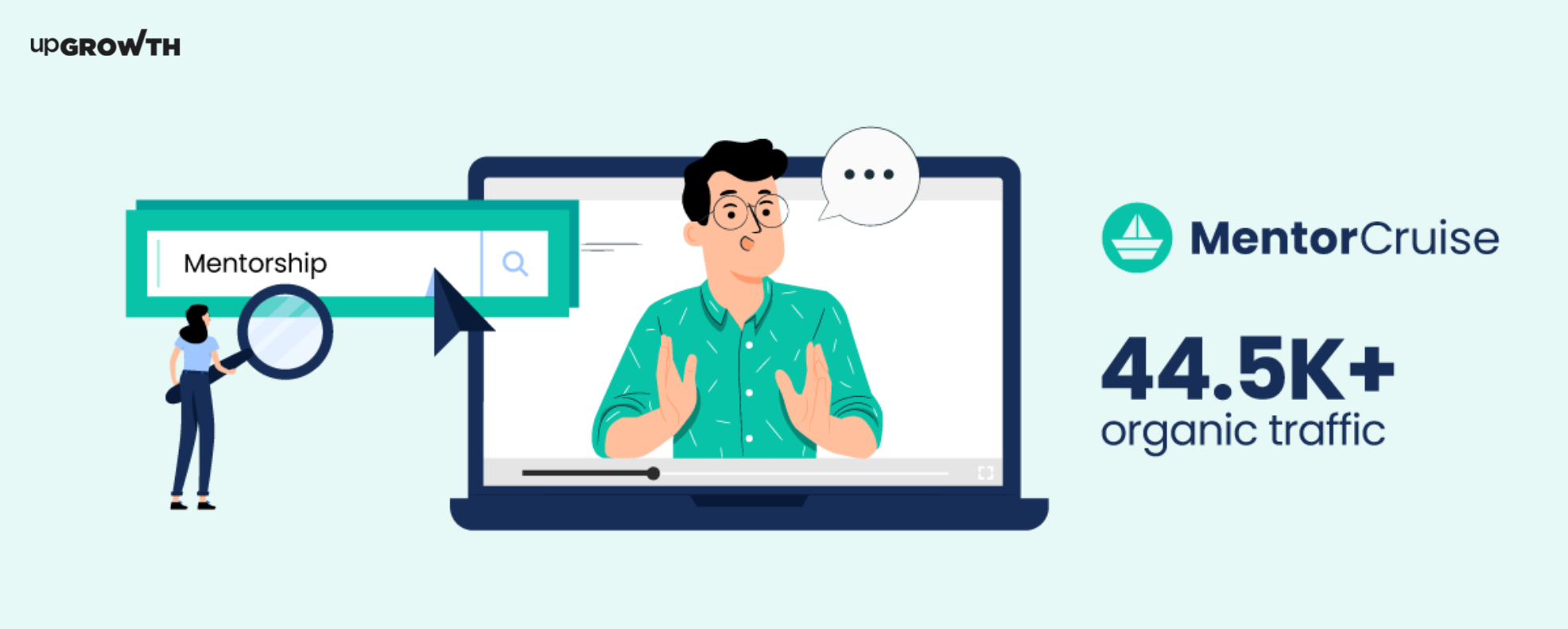
MentorCruise’s programmatic SEO strategy optimizes dynamically generated mentor profiles, driving significant organic traffic and establishing the platform as a trusted resource for career advancement.
Overview of MentorCruise
MentorCruise is a career development platform that facilitates connections between qualified mentors and industry professionals with individuals seeking career advancement. The platform prioritizes accessibility and transparency to streamline the mentoring process and ensure effective partnerships.
A brief overview of MentorCruise’s programmatic SEO strategy
MentorCruise’s programmatic SEO strategy focuses on automating the optimization of its dynamically generated mentor profile pages. Here’s a breakdown:
Template-based optimization: MentorCruise uses pre-defined templates for mentor profiles. These templates can be optimized with relevant keywords and title tags to improve search engine ranking.
Dynamic content optimization: Data points like mentor names, skills, and descriptions are programmatically inserted into the templates. This content can be optimized for relevant keywords as well.
Structured data implementation: MentorCruise leverages structured data markup to provide search engines with richer information about mentors, potentially leading to richer search results.
Internal linking: Strategically linking mentor profiles to relevant category or collection pages within the platform.
Content freshness: Regularly updating mentor profiles with new information or achievements could improve ranking.
Segregation of traffic numbers behind MentorCruise’s programmatic SEO strategy
Direct: 45.5% (68K)
Organic Search: 43.95% (65.7K)
A healthy balance between direct and organic traffic signifies a strong online presence. Here’s why MentorCruise’s traffic breakdown is impressive:
High Brand Awareness: A significant portion of traffic coming directly suggests brand recognition. People know MentorCruise exists and visit directly, indicating a well-established reputation.
Effective SEO Strategy: The substantial organic traffic demonstrates MentorCruise’s success in search engine optimization. They are ranking well for relevant searches, attracting potential customers organically.
Diversified Traffic Sources: Relying solely on one traffic source can be risky. MentorCruise’s balanced traffic distribution makes them less vulnerable to fluctuations in search engine algorithms or marketing trends.
Overall, MentorCruise’s traffic breakdown suggests a well-rounded online marketing strategy with a strong brand presence and effective SEO efforts.
A Deep Dive into the Structure of MentorCruise Pages/Section
Here is a deep dive into the Structure of MentorCruise Programmatic SEO. MentorCruise leverages programmatic SEO to optimize various aspects of its platform. Let’s delve into a case study to explore these techniques in action.
Find a Coach Pages
MentorCruise leverages programmatic SEO to target informational and commercial queries related to finding coaches in specific niches. These dynamically generated pages, essentially functioning as landing pages, cater to users searching for “{niche} coach” and related coaching services.
Let’s explore some examples of these programmatic pages and analyze their monthly organic traffic volume.
Example page
Monthly organic traffic
Find a Software Engineering coach and coaching
49
Find a Startup coach and coaching
59
Find a Digital Marketing coach and coaching
68
Data Points
MentorCruise leverages these data points for its programmatically generated pages:
A title and description for coaching in the category
CTA button
List of Top Coaches in the category with pricing, details and CTAs
List of other types of experts in the category
Reviews of the coach
Find a Mentor Page
MentorCruise caters to a specific audience seeking qualified mentors and informative or commercially-driven mentoring experiences. The platform utilizes programmatic SEO to generate targeted landing pages that facilitate finding the right mentor and mentoring program.
Let’s explore some examples of these programmatically generated pages and analyze their monthly organic traffic volume.
Example page
Monthly organic traffic
Find a UX Design mentor and mentoring
51
Find a Engineering mentor and mentoring
63
Find a Startup mentor and mentoring
69
Data Points
To create dynamic and informative mentor profiles, MentorCruise incorporates these data points::
A title and description for mentoring in the category
CTA button
List of Top Mentors in the category with pricing, details and CTAs
List of other types of experts in the category
Reviews of the mentor
Build a programmatic SEO Strategy with uG
Witnessing MentorCruise’s success with programmatic SEO (pSEO) showcases its potential for significant organic traffic growth. To emulate this achievement, partnering with seasoned pSEO experts like upGrowth is a strategic move.
Our deep understanding of pSEO can craft targeted landing pages, optimize content for dynamic profiles, and leverage automation to efficiently scale your SEO efforts. upGrowth will become your partner in maximizing your website’s visibility and organic traffic, propelling your growth to new heights.
Watch Now: How MentorCruise Programmatic SEO Drives 44.5K+ Monthly Organic Traffic
MentorCruise uses pre-defined templates for mentor profiles, incorporating relevant keywords and title tags to enhance search engine rankings and visibility.
By programmatically inserting data points like mentor names, skills, and descriptions into templates and leveraging structured data markup, MentorCruise provides search engines with rich information, improving search results.
With a healthy balance of direct (45.5%) and organic search (43.95%) traffic, MentorCruise demonstrates strong brand recognition and effective SEO mentoring efforts, attracting users directly and through search engines.
The platform regularly updates mentor profiles and strategically links them to relevant category pages, ensuring content freshness and improved rankings, which drives user engagement and conversions.
MentorCruise Programmatic SEO Success
How a mentorship platform drives high-intent organic traffic by scaling content across specific skills, careers, and mentorship types.
44.5K+
Monthly Organic Traffic
1. ‘Mentor for X’ Landing Pages
Creating template-based landing pages for every possible skill and tool (e.g., ‘Mentor for React,’ ‘Mentor for Product Management’) to capture highly specific, high-intent searches.
2. Career Path Programmatic Content
Generating pages for career transitions and learning paths (e.g., ‘How to Become a Data Scientist’) that organically recommend relevant mentors as the solution.
3. Comparison/Alternative Pages
Building programmatic comparisons (e.g., ‘MentorCruise vs. [Competitor]’) that highlight unique value propositions and capture users deep in the decision-making funnel.
4. Dynamically Generated Q&A
Using mentor-provided data to generate structured Q&A sections or FAQs for specific mentor profiles and skill pages, boosting E-E-A-T and targeting long-tail voice search queries.
FAQs
1. How does structured data improve MentorCruise’s search engine results?
Structured data enhances MentorCruise’s search engine results by providing clear, organised information that search engines can easily interpret. This leads to richer search results, such as enhanced snippets and knowledge panels, which attract more clicks and increase visibility. It ultimately helps in driving more organic traffic to the website.
2. What role does internal linking play in MentorCruise’s SEO strategy?
Internal linking plays a crucial role in MentorCruise’s SEO strategy by distributing page authority across the site, making it easier for search engines to crawl and index content. It helps users navigate the site more effectively, improving user experience and engagement. This strategy ensures that both new and existing content remains visible and accessible.
3.How does content freshness contribute to MentorCruise’s SEO success?
Content freshness contributes to MentorCruise’s SEO success by keeping the website relevant and up-to-date with the latest information and trends. Regularly updated content signals to search engines that the site is active and valuable, improving its ranking potential. Fresh content also meets user expectations, enhancing overall engagement and satisfaction.
4. What demonstrates the effectiveness of MentorCruise’s programmatic SEO efforts?
The effectiveness of MentorCruise’s programmatic SEO efforts is demonstrated by their achievement of over 44.5K monthly organic traffic, indicating successful visibility and user engagement. The balanced mix of direct and organic traffic showcases a strong brand presence and effective SEO strategy. High search rankings and rich search results further highlight their success in optimising for user search intent.
Glossary: Key Terms Explained
Programmatic SEO (pSEO) – A scalable SEO approach that uses templates, structured data, and automation to create optimized web pages at scale.
Template-Based Optimization – Using pre-designed page templates for dynamic content, which can be programmatically populated and SEO-optimized for keywords.
Dynamic Content Optimization – Automatically inserting variable data (e.g., mentor names, skills, descriptions) into templates to generate unique, SEO-friendly pages.
Structured Data – Code (often JSON-LD or Schema.org markup) added to web pages to help search engines understand content and display rich snippets in search results.
Internal Linking – Connecting pages within the same website to distribute authority, improve crawlability, and enhance user navigation.
Content Freshness – Regularly updating pages with new or relevant information to signal value to search engines and maintain rankings.
Direct Traffic – Visitors who access the website by typing the URL directly, using bookmarks, or through untracked sources.
Organic Search Traffic – Visitors who reach the website through unpaid search engine results.
Indexed Pages – Web pages recognized and stored by search engines, making them eligible to appear in search results.
Find a Coach Pages – Programmatically generated landing pages optimized for users searching for coaches in specific categories or niches.
Find a Mentor Pages – Pages dynamically created to help users find mentors in specific fields, optimized for SEO and user engagement.
CTA (Call-to-Action) Button – A clickable element prompting users to take a specific action, such as “Book Mentor” or “Learn More.”
Top Mentors/Coaches Listing – Curated lists of mentors or coaches in a category, often including profiles, pricing, reviews, and CTAs.
Rich Snippets – Enhanced search results displaying additional information like ratings, reviews, or event details, often powered by structured data.
Mentor Profile Pages – Individual pages for mentors showcasing skills, experience, and offerings, optimized for search engines via programmatic SEO.
Traffic Segregation – Analysis of traffic sources (direct, organic, referral, etc.) to understand audience behavior and website performance.
SEO Mentoring – Techniques and strategies applied to optimize mentor profile pages and related content for higher search visibility.
Landing Page Optimization – Structuring pages to maximize user engagement, conversions, and search ranking for targeted queries.
Search Intent – The goal or motivation behind a user’s search query, such as informational, commercial, or navigational intent.
Balanced Traffic Distribution – Maintaining a mix of traffic sources (direct, organic, referral) to reduce dependence on a single source and ensure stability.
Data Points for Profiles – Information elements used to populate mentor pages, such as titles, descriptions, pricing, reviews, and categories.
Mentor Categories – Specific areas of expertise (e.g., UX Design, Engineering, Digital Marketing) used to organize mentor profiles and programmatic pages.
SEO Visibility – The degree to which a website or page is discoverable and ranks in search engine results for relevant queries.
User Engagement – Interaction of visitors with content, including clicks, page views, or conversions, reflecting the effectiveness of SEO and content.
Programmatic Page Generation – Automated creation of multiple pages using templates and structured data for scalable SEO results.
MentorCruise’s programmatic SEO works by using a master template for mentor profiles and dynamically inserting unique data like names, skills, and industries. This creates thousands of optimized pages automatically, a method essential for scaling content and capturing niche, long-tail search queries without manual effort. The strategy’s power is evident in its contribution to the platform's 44.5K monthly organic visitors. The key is combining structure with specific data to serve user needs precisely. Your business can achieve similar results by focusing on these core pillars:
Template-Based Optimization: Establish a consistent, SEO-friendly structure for all dynamically generated pages, including title tags and meta descriptions.
Dynamic Content Integration: Programmatically pull data points from a database to populate the templates, creating unique value for each page.
Structured Data Markup: Implement schema to help search engines understand the content, which can lead to rich results and higher visibility.
This system transforms a database into a powerful asset for organic growth. To fully understand how to build this engine, consider a deeper analysis of their page structure.
Template-based optimization provides MentorCruise with a scalable and consistent framework for SEO across all its 17K+ indexed pages. This approach ensures that every dynamically generated mentor profile automatically adheres to SEO best practices, targeting specific long-tail keywords like “Find a Startup coach” with minimal ongoing effort. It is the backbone of their ability to rank for countless niche mentor searches. For your platform, a template-driven strategy creates efficiency and control by:
Ensuring SEO Consistency: Every new page for a mentor or coach inherits optimized URL structures, header tags, and internal linking patterns.
Simplifying Updates: You can update the SEO for thousands of pages at once by simply modifying the master template.
Targeting Keyword Patterns: Templates are designed around user search patterns, such as “Find a {category} Mentor,” systematically capturing predictable search intent.
By building a robust template, you create a system that works for you. The complete article offers more detail on how these templates are structured for maximum impact.
MentorCruise uses structured data to provide search engines with explicit, organized information about each mentor, such as their specialty, name, and services. This technical enhancement is critical because it enables richer, more informative search results, which can significantly boost click-through rates and distinguish their listings from competitors. For a platform with over 17K+ pages, this ensures their content is not just indexed but also understood and presented effectively. Implementing structured data helps you:
Achieve Rich Results: Your pages can appear with extra information like ratings, prices, or availability directly in the search results.
Improve Topical Authority: It signals to search engines that your pages are authoritative sources on specific topics, like “Digital Marketing coach.”
Enhance Context: It clarifies the relationship between different data points on a page, helping search engines serve your content for more relevant queries.
Properly applied structured data is a powerful differentiator in a crowded digital space. Dive deeper into the specific schemas MentorCruise uses to see how this could apply to your platform.
A programmatic SEO model, like the one used by MentorCruise, excels at scalability and targeting specific, high-intent user queries, whereas traditional blogging is better for building broad topical authority and engaging users at the top of the funnel. MentorCruise's approach allows it to create thousands of targeted landing pages, like “Find a Software Engineering coach” which gets 49 monthly visits, something unfeasible with manual writing. When choosing an approach, you should weigh these factors:
Scalability: Programmatic SEO is unmatched for creating thousands of pages from a dataset. Traditional blogging is resource-intensive and scales slowly.
Search Intent: Programmatic pages effectively target commercial or transactional intent (“find a coach”), while blogs often target informational intent (“how to become a coach”).
Resource Allocation: Programmatic requires a significant upfront investment in development and data structuring, while blogging requires ongoing investment in writers and content strategists.
Many successful platforms blend both. MentorCruise's success with programmatic SEO shows its power for marketplaces. The full case study provides more context on when to choose one strategy over the other.
MentorCruise’s impressive organic traffic share of 43.95%, representing 65.7K monthly visitors, is a powerful testament to programmatic SEO as a sustainable and cost-effective user acquisition channel. It shows that by systematically turning their core data into search-friendly pages, they have built a powerful engine that consistently attracts high-intent users without relying heavily on paid advertising. This strategy builds a defensible moat that grows more valuable over time. For your business, this approach offers:
Reduced Customer Acquisition Cost (CAC): Organic traffic is effectively free, lowering your overall marketing spend per acquired customer.
Compounding Growth: Unlike paid ads, which stop when you stop paying, SEO assets can grow in value and continue to attract traffic over time.
Enhanced Brand Authority: Ranking for thousands of specific terms positions your platform as the go-to resource in its domain.
This evidence makes a strong case for investing in programmatic SEO as a primary growth lever. Explore the complete traffic breakdown to see how this strategy fits into a diversified marketing mix.
MentorCruise's “Find a {category} Coach” pages brilliantly capture both user intents by combining informational elements with clear commercial calls-to-action. For example, a page like “Find a Digital Marketing coach and coaching” (68 monthly visits) serves users who are both researching what a coach does and those ready to hire one. This dual-purpose design broadens their reach and effectively moves users through the conversion funnel. Your landing pages can achieve this by:
Addressing Informational Queries: Include content that defines the role of a coach in that niche, outlines benefits, and answers common questions.
Satisfying Commercial Intent: Prominently feature a searchable, filterable list of available coaches with clear profiles and an easy way to connect.
Using Targeted Keywords: The page titles and content use keyword patterns that match what users type when they are at different stages of their search journey.
This blended approach maximizes the value of each programmatic page. Discover more about how their page layout and content hierarchy achieve this balance in the full analysis.
This balanced traffic distribution highlights a mature and healthy marketing strategy where strong brand recognition complements powerful SEO. The high direct traffic (68K visitors) shows that MentorCruise has successfully built a memorable brand that users seek out by name, while the equally strong organic traffic shows they can attract new users who are not yet aware of them. This diversification is a sign of a resilient online presence. A healthy traffic mix like this indicates:
Strong Brand Recall: Users are typing the URL directly or searching for the brand, which is a result of effective branding, PR, or word-of-mouth.
Sustainable Growth Engine: The platform is not overly reliant on a single channel, protecting it from algorithm updates or shifting market trends.
Effective Full-Funnel Marketing: The company is successfully capturing users at all stages, from initial discovery via search to direct engagement from loyal users.
Striving for this balance is a key goal for long-term digital success. The article provides further insights into how these two channels can work together to fuel growth.
For a marketplace, the first step is to structure your data and identify the core components for your page templates. MentorCruise built its strategy on a foundation of well-organized mentor data, which is the fuel for its programmatic engine that now drives 44.5K in monthly organic traffic. Before writing any code, you must focus on creating a scalable content framework. Your implementation plan should begin with these actions:
Step 1: Identify Key Data Points: Determine all the unique attributes of your listings (e.g., for mentors: skills, industry, experience; for products: brand, color, size).
Step 2: Define URL and Page Structure: Design a clean, keyword-rich URL pattern (e.g., /mentors/digital-marketing/) and a template with designated spots for your data.
Step 3: Map Keywords to Page Types: Research how users search for your listings and create page templates that align with those query patterns, like MentorCruise’s “Find a {category} Mentor.”
Getting this data architecture right from the start is essential for a successful programmatic project. See the full case study for a more detailed breakdown of their page structure.
To successfully create programmatic collection pages, you must first collect and structure data that adds unique value and can be combined in meaningful ways. MentorCruise's strategy is effective because its pages are built from rich, specific data points that directly answer user needs, contributing to its 17K+ indexed pages. The goal is to move beyond simple keyword insertion and create genuinely useful resources. Focus on collecting and structuring these types of data:
Categorical Data: Core nouns that define the collection, such as specialty, industry, or location (e.g., 'Startup', 'UX Design').
Descriptive Attributes: Adjectives or unique features that allow for filtering and create long-tail value (e.g., 'certified', 'ex-Google', 'remote-friendly').
Quantitative Metrics: Numbers that build trust and provide quick comparisons (e.g., years of experience, sessions completed, user rating).
Related Entities: Connections to other data points that enable powerful internal linking (e.g., tools used, topics covered).
This structured data is the raw material for your entire programmatic SEO engine. The full article explores how MentorCruise likely sources and organizes this information.
To stay ahead, MentorCruise will need to evolve its programmatic strategy beyond keyword-driven templates by enriching its pages with more dynamic, user-generated, and unique content. While their current model effectively generates 44.5K monthly organic visits, future search algorithms will likely reward pages that demonstrate deeper value and engagement. A forward-thinking strategy should incorporate:
Integration of User-Generated Content: Adding reviews, Q&As, or project summaries from mentees directly onto mentor profiles to add unique, fresh text.
More Sophisticated Internal Linking: Moving beyond simple category links to contextually recommend related mentors or resources based on user behavior.
Unique Data Visualizations: Programmatically creating charts or graphs that showcase a mentor's experience or mentee success stories.
AI-Powered Content Summaries: Using AI to generate unique introductory paragraphs for each mentor, reducing template duplication.
Continuous enhancement is key to ensuring programmatic pages remain competitive. Discover more about future-proofing SEO strategies in the full analysis.
The most common mistake is creating thin, low-quality pages at scale, which can lead to search engine penalties. MentorCruise avoids this pitfall by ensuring each of its 17K+ dynamically generated pages is built from a rich set of unique data points, providing genuine value to the user rather than just targeting a keyword. Their structured approach sidesteps the classic problem of duplicate content. Key mistakes you should avoid include:
Insufficient Data Variation: If pages are nearly identical except for a title, they provide little unique value. MentorCruise succeeds by using multiple unique data points per mentor.
Poor User Experience: Creating pages that are difficult to navigate or use, even if they are optimized for keywords.
Ignoring Internal Linking: Generating thousands of orphan pages that are not properly linked within the site architecture.
Success in programmatic SEO comes from a commitment to quality at scale. The full article explains how a data-first mindset prevents these errors.
MentorCruise’s extensive index of 17K+ pages suggests a sophisticated internal linking strategy is in place to ensure these pages are discoverable and valued by search engines. Instead of creating isolated pages, they likely use their “Find a Coach” category pages to act as hubs, distributing authority down to individual mentor profiles. This creates a logical site structure that benefits both users and search crawlers. You can apply these principles by:
Creating Hub and Spoke Models: Use broad category pages (the hub) to link to more specific profile pages (the spokes), channeling link equity effectively.
Implementing Contextual Links: Programmatically add links between related mentors or topics, helping users discover more relevant content and signaling relationships to Google.
Using Breadcrumbs: Ensure every profile page has a clear breadcrumb trail, reinforcing the site hierarchy and improving navigation.
An intelligent internal linking structure transforms a large number of pages from a liability into a powerful asset. The full article provides more examples of how to build these connections at scale.
Amol has helped catalyse business growth with his strategic & data-driven methodologies. With a decade of experience in the field of marketing, he has donned multiple hats, from channel optimization, data analytics and creative brand positioning to growth engineering and sales.

 Growth Strategy and Planning
 Inbound Growth
 Growth Hacking
 Fractional CMO
 Search Engine Optimization
 Paid and Performance Marketing
 Social Media Marketing
 Demand Generation
 AI-Driven Growth Strategy
 AI-Native Workflow Automation
 Generative Engine Optimization
 Grove — AI Growth Strategist

 AI Automation
 Framework
 Case Study
 Tools
Tools Growth Tools
 Decision Tree
 Compare
 Custom GPT's
 Guides
 Offer
Offer Webstories
 Quizzes
 Blog
Blog AI-powered Apps
 Social Media Tools
 Agency Fit Score