Contributors:
Amol Ghemud Published: October 16, 2025
Summary
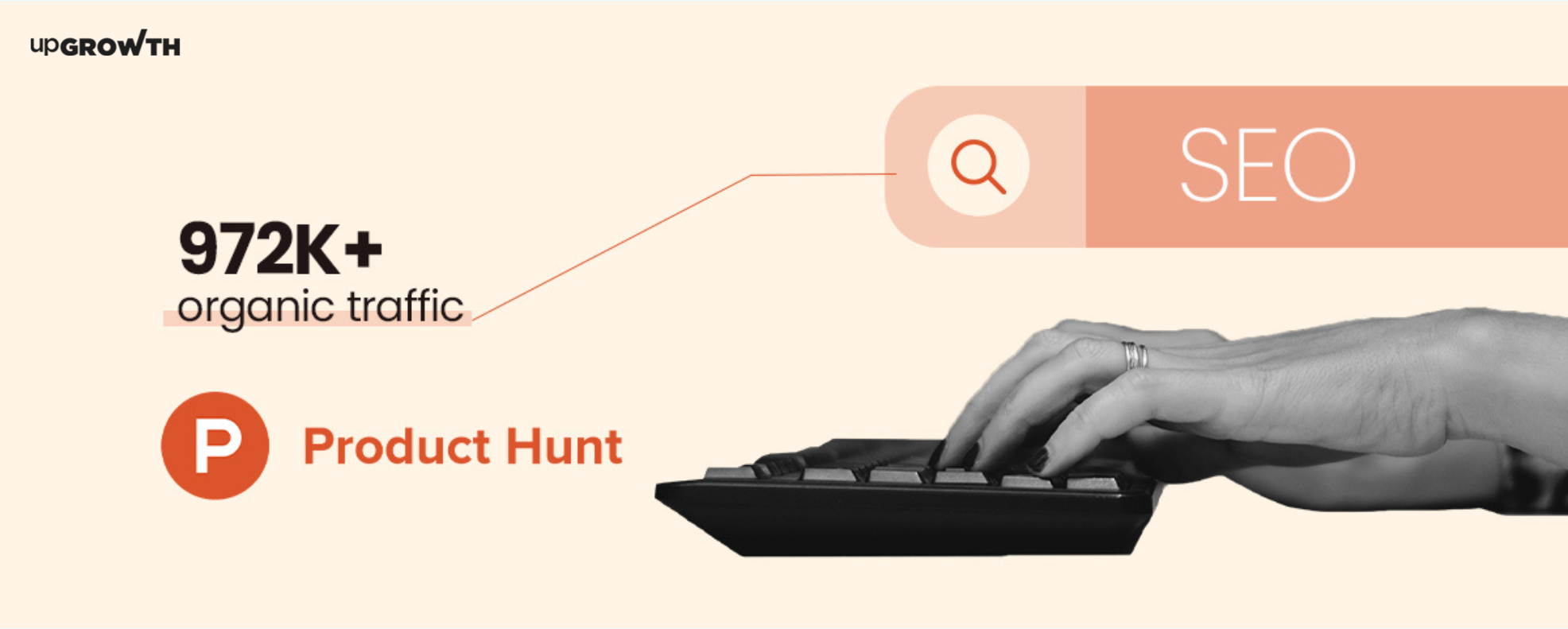
What: A comprehensive breakdown of how Product Hunt leverages programmatic SEO (pSEO) to attract over 790,000 monthly organic visitors and expand its digital reach. Who: SEO strategists, startup marketers, and tech community platforms aiming to boost visibility through long-tail keyword targeting and automated content creation. Why: Product Hunt’s success illustrates how programmatically generated product profile pages can enhance discoverability, audience engagement, and brand authority. How: By automating the creation of product-focused pages optimized for long-tail keywords, combining direct and organic traffic strategies to achieve sustainable growth and strong search performance.
In This Article
Share On:
Product Hunt leverages programmatic SEO to enhance visibility for a wide array of products by targeting long-tail keywords and automating content creation.
Overview of Product Hunt
Product Hunt is a leading platform for discovering new products and services. It enables users to upvote, subscribe to daily digests, and explore trending offerings. The platform also supports creators with podcasts, job listings, and a collaborative forum.
A brief overview of Product Hunt programmatic SEO strategy
Product Hunt leverages programmatic SEO to enhance the organic search visibility of its product profile pages. Here’s a breakdown of their approach:
Targeting Long-Tail Keywords: Product Hunt programmatic SEO leverages product names and categories to create highly relevant, long-tail keyword content, attracting targeted organic traffic.”
Automated Content Creation: Templates and automation tools streamline content creation, allowing for efficient generation of product descriptions, features, and other relevant information.
Landing Page Focus: Programmatically generated content creates essentially landing pages for each product, optimizing them for search engines.
This product hunt programmatic SEO strategy enables Product Hunt to capture organic traffic for a vast array of products, potentially driving more users to explore the platform and discover new offerings.
Segregation of traffic numbers behind Product Hunt programmatic SEO strategy
Direct: 36.58% (1.7M)
Organic Search: 40.82% (1.9M)
A healthy mix of direct and organic traffic like this indicates a strong brand presence:
High Direct Traffic: A significant portion of visitors coming directly implies brand awareness and trust. People know Product Hunt exists and go there intentionally, suggesting a strong brand reputation.
High Organic Traffic: This indicates successful SEO efforts. Product Hunt is ranking well for relevant search terms, attracting a steady stream of new users actively seeking what they offer.
Having a balance between these two sources shows Product Hunt is not solely reliant on search engines but also has a loyal user base that comes back directly. This combination is ideal for sustainable website growth.
With 40.82% of traffic coming from organic search, Product Hunt’s programmatic SEO effectively attracts users searching for specific products. Direct traffic (36.58%) shows strong brand loyalty, indicating that users frequently return to the platform
Product Hunt targets {product name}
OnlyFinder – The OnlyFans Search Engine
Factle.app
This Person Does Not Exist
Product Hunt targets {product} alternatives
Bypass Paywalls alternatives
Moviedle alternatives
SpyDialer – Reverse Phone Lookup alternatives
A Deep Dive into the Structure of Product Hunt Pages/Section
Here is a Deep Dive into the structure of Product Hunt Programmatic SEO. Product Hunt leverages programmatic SEO techniques to optimize specific areas of their website. This case study delves deeper into how they achieve this.
Product profile page
Product Hunt employs programmatic SEO to target individual product names, creating informational landing pages within the product profile section. These programmatically generated pages function similarly to traditional landing pages.
To illustrate the effectiveness of this approach, we can examine real-world examples and their associated monthly organic traffic figures.
Example page
Monthly organic traffic
This Person Does Not Exist
2.3k
Factle.app
2.5k
OnlyFinder – The OnlyFans Search Engine
2.8k
Data Points
These programmatically generated pages leverage various data elements, including the following:
The name and logo of the app
A short description of the app and what it does
Few clear CTA buttons
Image, screenshots, and a long description of the app
Ratings, comments, and other related products
Build a programmatic SEO Strategy with upGrowth
Product Hunt’s success with programmatic SEO (pSEO) exemplifies the power of this approach in driving organic traffic and brand awareness. pSEO leverages automation and data-driven insights to optimize content for specific keywords, attracting a wider audience through search engines.Integrating an effective on-page SEO strategy alongside programmatic techniques ensures that each page is fully optimized for search engines.
upGrowth’s team possesses the deep knowledge and technical expertise to craft a tailored programmatic SEO strategy that propels your website to the top of search engine rankings, significantly increasing qualified leads and organic traffic.
If you’re looking to emulate Product Hunt’s results, partnering with a seasoned pSEO expert like upGrowth can be a game-changer.
Key Takeaways
Product Hunt’s programmatic SEO strategy significantly boosts the visibility of its product profile pages by targeting long-tail keywords, making it easier for users to discover a wide range of products.
By automating the content creation process, Product Hunt can quickly generate informative and relevant content for numerous products, ensuring each product page is well-optimized for search engines.
Focusing on long-tail keywords allows Product Hunt to attract highly targeted organic traffic, bringing in users who are specifically searching for the products listed on the platform.
The strategy helps balance organic search traffic with direct traffic, indicating strong brand recognition and loyalty, as users both find Product Hunt through search engines and return directly to the platform.
Product Hunt’s Community-Powered SEO Grid
Product Hunt leverages user submissions and community categorization to generate authority across three distinct programmatic content pillars.
🚀
INDIVIDUAL PRODUCT PAGES
High organic ranking due to fresh, constant **user-generated content** (UGC) in comments.
Targets specific tool names and transactional keywords.
🏷️
NICHE COLLECTION PAGES
Programmatically created **comparison lists** (e.g., “Best AI Tools for X”).
1.What are the main elements of Product Hunt’s programmatic SEO strategy?
Product Hunt’s programmatic SEO strategy includes automated content creation, extensive use of user-generated content, and targeting niche product categories to attract diverse organic traffic.
2.How does Product Hunt target long-tail keywords related to product names?
Product Hunt targets long-tail keywords by creating detailed product profile pages for each listed product, optimising these pages for specific and relevant search terms associated with the product names.
3. What types of pages does Product Hunt create using programmatic SEO?
Product Hunt creates various pages such as product profile pages, category pages, and curated lists highlighting trending products, utilising programmatic SEO to scale content efficiently.
4. How does automated content creation benefit Product Hunt’s SEO strategy?
Automated content creation allows Product Hunt to quickly generate a large volume of high-quality, keyword-optimized pages, which improves search engine visibility and drives more organic traffic.
5. What role do product profile pages play in driving Product Hunt’s organic traffic?
Product profile pages serve as detailed, SEO-optimized entries for each product. They attract search traffic through relevant keywords and provide valuable information that engages users and encourages repeat visits.
1. Programmatic SEO: An automated SEO approach that creates large volumes of web pages using structured data to target long-tail keywords efficiently.
2. Long-Tail Keywords: Specific, niche search phrases that attract highly targeted traffic and have lower competition than broad keywords.
3. Landing Page: A standalone web page designed to capture user interest or conversions, often optimized for a single keyword or intent.
4. Organic Traffic: Visitors who arrive on a website through unpaid search results rather than through ads or direct visits.
5. Automation Tools: Software solutions used to streamline repetitive SEO tasks like content generation, keyword mapping, and page creation.
6. Automation Tools: Software or systems that streamline repetitive SEO and content creation tasks. Product Hunt uses automation to generate consistent, structured product pages at scale, reducing manual effort while maintaining quality and keyword relevance.
7. User-Generated Content (UGC): Content created by users rather than the brand itself, such as reviews, comments, and upvotes. Product Hunt’s UGC boosts engagement and adds SEO value by keeping pages active, authentic, and frequently updated.
8. Search Intent: The underlying goal behind a user’s query, whether they want to find information, compare options, or make a purchase. Product Hunt’s pSEO aligns page content with specific search intents, ensuring high relevance and ranking potential.
9. Indexation: The process by which Google and other search engines add web pages to their databases. Product Hunt’s 500K+ indexed pages demonstrate how effectively its programmatic SEO structure supports large-scale discoverability.
For Curious Minds
Product Hunt masterfully transforms product names and categories into highly specific long-tail keywords, creating thousands of dedicated landing pages that capture targeted search intent. This automated content strategy is essential for achieving visibility at scale, allowing them to rank for niche queries that competitors often overlook. By programmatically generating pages for terms like “OnlyFinder - The OnlyFans Search Engine” or “Factle.app,” the platform attracts users with a pre-existing interest in those specific tools, leading to higher engagement and a significant portion of their 40.82% organic traffic. This method turns their extensive product database into a powerful SEO asset, ensuring that as new products are added, their organic footprint automatically expands. To explore how this scalable content engine is built, you can find more details in the full analysis.
Product Hunt avoids thin content penalties by ensuring each programmatically generated page is populated with distinct and useful data points, creating a unique profile for every product. This strategy hinges on a well-structured template that pulls specific information for each entry, rather than just repeating boilerplate text. The key is to build pages that serve user intent with structured, valuable information. The essential elements they incorporate include:
The unique name and logo of the application.
A concise, descriptive summary of the app’s function and purpose.
A few prominent and clear call-to-action (CTA) buttons.
User-generated content like upvotes and comments, which adds unique text and social proof.
By combining these structured data points with user engagement signals, each of the 515K pages offers genuine value, justifying its indexation. Discover the complete page structure by reading the full case study.
The success of these individual pages provides clear evidence that users frequently search for specific digital products by name. For instance, the page for “This Person Does Not Exist” attracts 2.3k monthly organic visitors, while “Factle.app” draws 2.5k, demonstrating that Product Hunt effectively captures this high-intent traffic. This strategy validates the idea that every product listed on a platform is a potential entry point for new users. These metrics show that their programmatic approach isn't just a theory; it is a proven driver of qualified traffic. By creating an optimized, informational hub for each product, Product Hunt positions itself as the default discovery destination, intercepting users at the exact moment they show interest. The full report offers more examples and data on how this translates to overall platform growth.
This nearly even split between organic and direct traffic signifies a remarkably healthy and sustainable growth model, blending strong brand recognition with effective customer acquisition. The high direct traffic (36.58%) indicates that Product Hunt has cultivated a loyal user base that trusts the platform and visits it intentionally, reducing reliance on external channels. Simultaneously, the robust organic traffic (40.82%) proves their programmatic SEO strategy is constantly attracting new users who are actively searching for products. This dual-engine approach creates a virtuous cycle: SEO attracts new users, and a great user experience converts them into loyal, direct visitors. For other platforms, this balance is the ideal state, demonstrating that you are not only discoverable to new audiences but also valuable enough to retain them. Learn more about achieving this strategic equilibrium in the full analysis.
Product Hunt’s two page types target users at distinct stages of the buyer’s journey. Single product pages (e.g., “SpyDialer”) are informational, capturing users with awareness-stage queries who are looking up a specific tool. In contrast, 'alternatives' pages (e.g., “Moviedle alternatives”) are comparative and target users in the consideration or decision stage who are actively evaluating their options. The 'alternatives' pages are designed to capture higher-intent commercial traffic, as users searching for alternatives are often looking to switch or make a purchase. While both strategies are crucial for comprehensive SEO coverage, the 'alternatives' pages likely yield more conversions because they directly address a user's need for comparison and choice. A detailed look into how these different page types work together is available in the complete case study.
To emulate Product Hunt's effective model, your platform should focus on creating a scalable system for generating unique, data-rich product pages. The initial implementation involves a few core steps that lay the foundation for automated content creation. A successful strategy begins with a structured approach to data and templating before any pages are generated.
Here is a four-step plan to get started:
Identify Key Data Points: Define the essential pieces of information for each product page, such as the product name, logo, a short description, category, and clear calls-to-action (CTAs).
Design a Master Template: Create a standardized page layout that programmatically populates the identified data points into an SEO-friendly HTML structure.
Automate Page Creation: Implement a system that automatically generates a new, unique URL and page for each product added to your database.
Optimize for Long-Tail Keywords: Configure your template to use the product name and category in page titles, meta descriptions, and headers to target specific search queries.
Following this blueprint helps build a powerful content engine. For a deeper dive into technical execution, view the full guide.
Product Hunt extends its programmatic strategy beyond individual product pages by systematically creating content hubs around categories and common search modifiers. This approach builds topical authority, signaling to Google that the platform is a comprehensive resource for the software and tech product space. By generating pages for both specific products and broader comparison queries, they cover the entire search landscape. For example, while a page for 'SpyDialer' targets a specific brand query, the 'SpyDialer - Reverse Phone Lookup alternatives' page captures a different, more solution-oriented user. This multi-layered strategy allows them to rank for a vast array of keywords, from narrow product lookups to broader exploratory searches, reinforcing their market leadership. Uncover more about their advanced content structuring techniques in the full article.
Deploying programmatic SEO at this scale introduces significant technical hurdles, primarily related to crawl budget management, indexation, and maintaining content quality. Generating over 515K pages can strain server resources and dilute Google's crawl budget, meaning some pages may not get indexed efficiently. A key to mitigation is focusing on technical excellence and internal linking to signal page importance. Common challenges and solutions include:
Crawl Budget Waste: Use a clean URL structure, a comprehensive XML sitemap, and a well-organized internal linking strategy to guide search engine bots to your most important pages.
Duplicate or Thin Content: Ensure each page template pulls enough unique data points (e.g., product descriptions, user reviews, specs) to provide distinct value.
Slow Page Load Speed: Optimize images, use efficient code, and employ caching to ensure that the server can handle rendering thousands of pages quickly.
Overcoming these technical barriers is essential for a programmatic strategy to succeed. The detailed analysis provides further insight into the technical architecture required.
Product Hunt's success demonstrates that brand building and aggressive SEO are not mutually exclusive but are instead two powerful, complementary growth levers. While its 36.58% direct traffic proves it has a strong, memorable brand, the 1.9M monthly organic visitors highlight the immense potential of systematically acquiring new users via search. This dual-focus strategy proves that platforms can simultaneously build a loyal community while casting a wide net for new user discovery. The conventional wisdom often pits brand marketing against performance marketing, but Product Hunt’s data shows that a programmatic SEO engine can be a primary driver of growth that feeds the brand flywheel. New users discover the site via search, have a positive experience, and return directly next time. Explore how to integrate these two growth engines in our complete analysis.
While Product Hunt's current keyword-focused programmatic SEO is highly effective, its future success will depend on evolving toward a more semantic and entity-based approach. As search engines prioritize understanding topics and user intent over exact-match keywords, simply generating pages based on product names will not be enough. The strategy must shift from creating pages to creating interconnected knowledge graphs. Future adjustments should include:
Enhancing Structured Data: Implementing more advanced schema markup to clearly define products, creators, and their relationships as entities.
Integrating More Unique Content: Programmatically incorporating richer, more diverse content like founder interviews, usage statistics, or integration guides.
Building Topical Clusters: Strengthening the internal linking between individual products, categories, and 'alternatives' pages to build a more robust topical map.
This evolution will ensure their pages continue to be seen as authoritative resources. Learn more about future-proofing SEO in the full report.
Programmatic SEO provides a solution to the scalability problem that plagues manual content creation on large platforms. Manually writing unique articles for each of Product Hunt’s 515K indexed pages would be logistically impossible and cost-prohibitive. Programmatic SEO automates this process by using templates and a structured database to generate optimized pages at scale. This approach offers superior efficiency because one well-designed template can create thousands of pages, each targeting a specific long-tail keyword like a product name. While manual content is ideal for in-depth pillar pages, a programmatic strategy is unmatched for achieving breadth and covering a vast number of niche topics, ultimately driving a significant volume of traffic like Product Hunt’s 1.9M monthly organic visitors. The detailed case study explores the resource allocation benefits further.
Product Hunt's ability to capture search traffic for specific product names reveals a powerful synergy between off-platform brand building and on-platform SEO. When a new product launches and generates buzz on social media, in newsletters, or through PR, people's first action is often to search for it by name on Google. Product Hunt’s programmatic SEO ensures they are waiting with an optimized landing page to capture that exact search intent. This symbiotic relationship means that the marketing efforts of every product creator indirectly fuel Product Hunt’s organic traffic. Their platform becomes the default discovery hub, benefiting from the collective brand awareness of the entire startup ecosystem. This strategy of leveraging external hype is a core component of their growth, as detailed in the full analysis.
Amol has helped catalyse business growth with his strategic & data-driven methodologies. With a decade of experience in the field of marketing, he has donned multiple hats, from channel optimization, data analytics and creative brand positioning to growth engineering and sales.

 Growth Strategy and Planning
 Inbound Growth
 Growth Hacking
 Fractional CMO
 Search Engine Optimization
 Paid and Performance Marketing
 Social Media Marketing
 Demand Generation
 AI-Driven Growth Strategy
 AI-Native Workflow Automation
 Generative Engine Optimization
 Grove — AI Growth Strategist

 AI Automation
 Framework
 Case Study
 Tools
Tools Growth Tools
 Decision Tree
 Compare
 Custom GPT's
 AI Answer Gap
 Offer
Offer Webstories
 Quizzes
 Blog
Blog AI-powered Apps
 Social Media Tools
 Agency Fit Score