Contributors:
Amol Ghemud Published: August 14, 2018
Summary
Introducing tools to identify and resolve Google penalties impacting SEO. These include the AccuRanker ‘Google Grump’ rating, the Panguin Tool, Moz’s Google Algorithm Change History, SEMrush Sensor, Fruition’s Google Penalty Checker, and Rank Ranger. Each tool offers unique features to help diagnose and remedy issues caused by Google’s algorithm updates or penalties for non-compliance with SEO best practices.
In This Article
Share On:
Google Penalties Checker Tools that will fix your SEO Problems
Let’s understand the context and everything else about Google Penalties Checker. Businesses have exclusively relied on web analytics to decide what was (or weren’t) effective. The future decisions are affected by where to invest time and money. The SEO consultants or the digital marketers find it difficult to agree with the businesses and their need to grow in search results and page ranks inorganically. Convincing the businesses of the pitfalls of indulging in repressive methods for SEO can get difficult at times.
With the search engine algorithms being updated very often and the advent of artificial intelligence in the engines, digital marketers find it tough to convince the businesses of dropping old methods, tools and techniques. What the businesses do not realize is that getting penalized by Google for using black hat SEO techniques or repressive methods mentioned below can make their website unmanageable.
The challenges or problems faced by digital marketers are as follows:
Google and the market are dynamic in nature
Getting the rankings and the traffic arriving at the website is not static whereas it changes based on the efforts put in by the SEO marketers.
The digital marketers have to cope with the ever-changing environment — evolving technologies, Google’s shifting algorithms, behavioural changes in your market, new apps and devices, etc.
Frequent Changes On The SERPs
Search engine results pages (SERPs) have changed a lot. Google is aggressively promoting vertical/universal search, placing its own products above organic search results which are pushed further down.
For some businesses, even a #3 ranking for high volume keywords has led to a disastrous drop in organic search traffic.
What is a Google Penalty and why it happens?
A Google penalty is a punishment handed out by Google. A Google penalty may result from an algorithm update initiated by Google. An example was the Mobilegeddon update that penalized sites for not being mobile-friendly. Penalties may also result from a manual review of the web page.
If businesses have utilized black hat SEO techniques, Google can penalize them in such scenario. The website must be in accordance with Google’s webmaster guidelines. That is the best way to avoid a penalty.
Penalties can vary in severity. The most common result is that your search ranking decreases. In extreme cases, you may end up being blocked from Google.
Some penalties can affect every page on a site. Others are specific to keywords pages. Some of the most common reasons for Google penalties include:
Manipulative or unscrupulous link-building activity
Google’s algorithm is getting increasingly sophisticated every year. That means it is harder to get away with underhanded SEO tactics on your site. A Google penalty can have a devastating impact on your business.
Track the Performance of your SEO strategies
SEO is the big fish that is consistently improving businesses’ reach
There are various tools available which provide an assessment of the penalties being levied by Google. Many google penalty checker tools are available online and can provide an assessment into the wrongdoings.
1. ‘Google Grump’ Rating
Google Grump is a powerful Google penalty checker tool from AccuRanker that provides each and every detail related to what is going on with Google Algorithms at present.
It provides insight into the active nature of algorithms in recent times, and whether a major update is expected in near future. To give you an easy evaluation, it rates the Google activities at four different levels, including:
Chilled
Cautious
Grumpy
Furious
After you have gone through a thorough monitoring process, it is time to understand the metrics and implement steps to make changes, and based on the evaluation, apply steps that will you’re your site safer in future updates.
2. Panguin Tool
Rightly named, after one of the Google algorithms, this Google penalty checker tool from Barracuda is very easy to use, highly effective and provides quick results. One needs to sign in using their Google Analytics accounts and make benefit of the graph to see how major algorithm updates could impact their website.
The large dashboard of icons helps you evaluate all the possible reasons that resulted in traffic drop.
3. Moz Google Algorithm Change History
Moz provides you with an insightful information about all the Google algorithms. It is one of the Google SEO penalty checkers which is termed as the most insightful provider of the reasons for the noncompliance with the guidelines.
The page contains lists of all the major updates, along with their dates, which are updated immediately in case of any new report. Through a detailed information related to any update, you can assess how such a situation can affect your site.
4. Semrush Sensor
SEMrush is a big name when it comes to guidance, knowledge, and discussion about Search Engine Optimization (SEO). This site provides you with the facility of a qualitative Google penalty checker tool, EMrush Sensor.
This tool provides an insight into what Google has been doing in the recent times, along with looking at individual niches too.
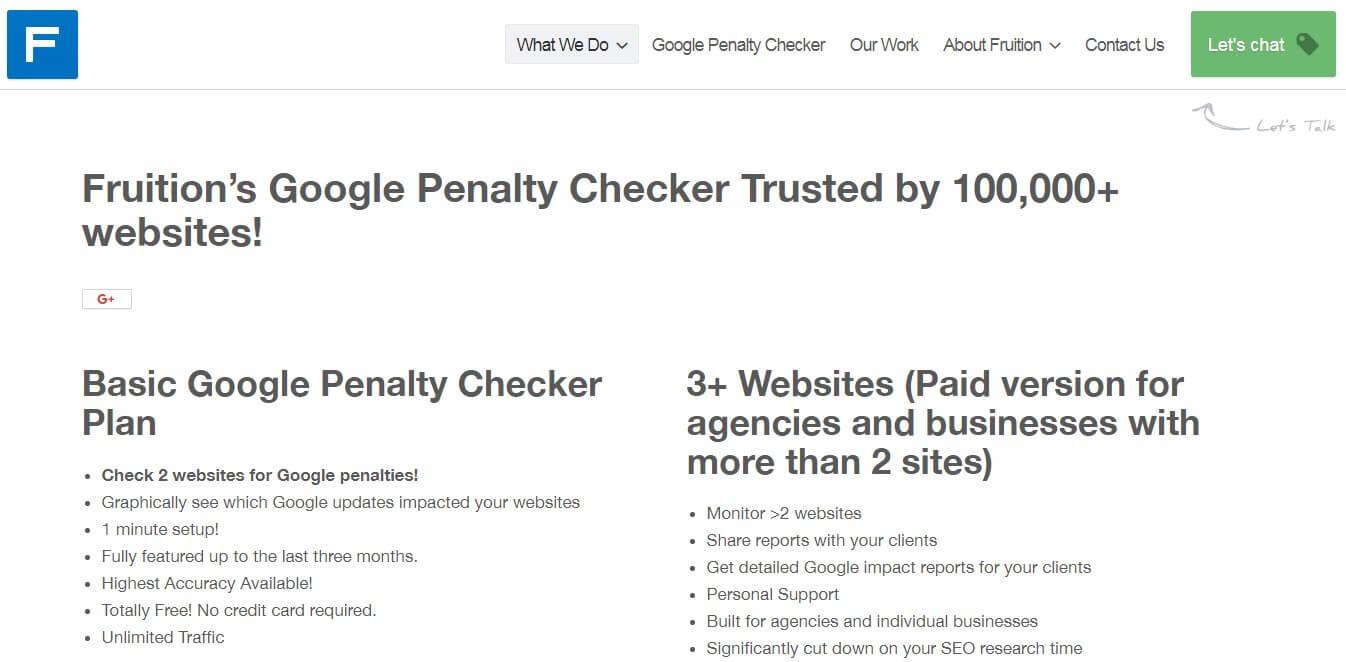
5. Google Penalty Checker from Fruition
This is a highly potent tool considering its effectiveness, as it provides precise information into what made the difference to your site. Available to use for free, you can have a look at recent updates through plot graphs, and how they have impacted your site.
6. Rank Ranger
At times, the updates by Google happen under the radar. They have not announced ahead of time or even after the fact. It can be challenging to keep track.
Rank Ranger is a free google penalties checker tool where users get access to detailed information about both public and phantom updates. (A phantom update is one that’s not announced.)
One thing users like about Rank Ranger is its easy-to-read charts. You will get a display that shows your site in one of three colors. Each color has a meaning. For example:
Blue indicates you have nothing to worry about
Green reports you are safe but not perfect
Red means your site is in danger of being penalized
Conclusion
Getting hit with a Google penalties can destroy your rankings overnight. Use one of these google penalties checker tools to identify the problem.
Then, take your time and resolve it. Going forward, monitor your site and stay abreast of the latest terms of services. These simple actions can help keep your website in good standing. Always keep a Google penalties checker tool in your back pocket, just in case.
FAQs
1. What is the Google penalty checker tool?
A Google penalty checker utility helps you determine whether you’ve been negatively affected by an algorithmic change or a human action, identifies the issue’s root cause, and offers advice on how to resolve it. In this article, we’ll look at a few tools that can help you rapidly compile these insights and restart your website.
2. What is Google penalty check in SEO?
A website that contains material that violates Google-enforced marketing principles is subject to a Google penalty. This punishment may result from a manual evaluation that reveals a website may have employed “black hat” SEO techniques or from an update to Google’s ranking algorithm.
3. How do I remove Google penalties?
Four Steps to Remove a Google Penalty
Implement the Disavow Tool. Link fines are frequent, and the only way to eliminate them is to remove the offending backlinks.
Fix Your Website to Comply with Google’s Requirements.
– Enhance the quality of content for users.
Send a request for reconsideration.
4. What kind of Google penalties can you get?
Downranking: These sanctions cause drops in search engine results and reduce website traffic for all queries on the offending sites. By performing a site: search, you can verify that all URLs have been delisted from the Google index because none of your URLs will appear in the search results.
5. Does Google Penalize pop-ups?
If you carry out any of the following, you risk losing ground in Google rankings: Just as the user arrives at the website from the search results, display a pop-up with the content of the primary site.
Watch: 6 Google Penalty Checker Tools to Fix Your SEO Issues
For Curious Minds
A Google penalty is a direct punishment against your website for violating its webmaster guidelines, leading to a significant decrease in search visibility or complete de-indexing. This is not just a temporary fluctuation, but a punitive action that can cripple your business's ability to attract new customers through organic search. Your site may be penalized due to algorithmic updates, like the Mobilegeddon update, or a manual review that uncovers manipulative tactics. To avoid this, you must prioritize ethical SEO that aligns with Google’s quality standards. A proactive approach to compliance is far more effective than a reactive recovery effort. Explore the full guide to see how tools like AccuRanker's Google Grump can help you monitor your site's health.
Black hat SEO refers to a set of aggressive and unethical tactics designed to manipulate search engine rankings in violation of publisher guidelines. This is a high-risk gamble that prioritizes short-term gains over long-term stability and brand reputation. Google's algorithms have become exceptionally skilled at identifying these schemes, meaning penalties are more a matter of when, not if. Common black hat techniques include:
Keyword stuffing: Overloading a page with keywords to an unnatural degree.
Private Blog Networks (PBNs): Using a network of websites solely to build links to a primary site.
Duplicate or thin content: Publishing low-value content with no unique insights.
Engaging in these practices directly invites a penalty that can erase your search presence. Discover the specific signals these tactics send to Google by reading our complete analysis.
The primary difference lies in their origin and resolution path, which critically shapes your response. An algorithmic penalty is an automated demotion applied by Google's systems when an update rolls out, while a manual action is a direct penalty from a human reviewer at Google who found a clear violation. An algorithmic penalty requires you to diagnose which quality guideline your site now violates and fix the underlying issue, with recovery happening after Google next crawls and re-evaluates your site. A manual action is communicated via Google Search Console and requires you to fix the specified problem and then submit a reconsideration request explaining the corrective actions you took. Manual actions often target specific, egregious violations like paid link schemes. Understanding which type you face is the first step, and the full article details tools for this diagnosis.
This seemingly contradictory outcome happens because the traditional 'ten blue links' on a search engine results page (SERP) are disappearing. A #3 organic ranking no longer guarantees high visibility or traffic when it appears below multiple ads, a featured snippet, a 'People Also Ask' box, and Google's own properties like Maps or Shopping results. Your high-ranking page is pushed far down the page, drastically reducing its click-through rate. This shift means that pure ranking is a vanity metric if it does not translate to actual clicks and engagement. Your strategy must now account for winning placement in these SERP features, not just achieving a specific organic rank. Learn more about adapting to the new SERP landscape in our detailed guide.
These tactics leave behind clear, unnatural patterns that Google's algorithms are specifically trained to identify. For instance, manipulative link-building often involves a sudden influx of links from low-authority or irrelevant websites, or a heavy concentration of exact-match anchor text, which are strong signals of an artificial scheme. Deceptive on-page tactics like keyword over-optimization create a poor user experience, which is measured through metrics like high bounce rates. Google cross-references trillions of data points to establish what a natural website profile looks like. Any significant deviation from these established norms, like those created by PBNs or paid links, raises a red flag for either an algorithmic demotion or a manual review. The full article details how to audit your site for these hidden risks.
To build a convincing case, you must replace subjective opinions with objective data that clearly illustrates the risk and the path forward. A data-driven argument is your most powerful tool for influencing business strategy and securing buy-in for long-term health. Here is a practical plan:
Benchmark Performance: Use web analytics to correlate traffic drops with known dates of major Google algorithm updates.
Run a Diagnostic Scan: Employ a tool like AccuRanker's Google Grump to get an initial assessment of potential penalties or algorithmic volatility affecting your niche.
Conduct a Backlink Audit: Analyze your link profile for toxic signs, such as too many links from low-quality or irrelevant sources.
Present a Risk Analysis: Create a report that shows the specific violations and connects them to the potential consequences, such as a complete loss of organic traffic.
Read on to discover how to frame these findings in a way that resonates with business objectives.
The increasing sophistication of Google's AI means your focus must shift from gaming the system to genuinely serving the user. A future-proof SEO strategy is built on sustainable, user-centric principles rather than chasing temporary algorithm loopholes. Instead of obsessing over keyword density, you should prioritize creating high-quality, unique content that demonstrates expertise and answers user questions thoroughly. Rather than pursuing manipulative links, you should focus on earning natural backlinks by becoming a trusted authority in your field. Your goal should be to build a website that Google wants to rank because it provides real value, making you resilient to future algorithmic shifts. Explore our guide for more on building a durable, authority-based SEO foundation.
The fundamental problem is that your backlink profile is a direct reflection of your site's authority and trustworthiness in Google's eyes. A profile cluttered with links from spammy, irrelevant, or low-quality sources signals that your site is either untrustworthy or is actively trying to manipulate rankings. This can lead to a severe penalty that suppresses your entire domain. The solution is a proactive backlink audit and cleanup process. You must regularly analyze incoming links and remove or disavow those that are harmful. This involves using SEO tools to identify toxic links, requesting their removal from the source website, and, as a last resort, using Google's Disavow Tool to tell the search engine to ignore them. Learn the precise steps for a successful backlink audit in the full article.
Many businesses inadvertently trigger penalties by making on-page errors that degrade the user experience and violate Google's guidelines. The core problem is often a disconnect between trying to rank and providing value to the visitor. Some of the most frequent mistakes include:
On-Site Keyword Over-Optimization: Forcing keywords into content unnaturally, making it unreadable.
Ad Heavy Page Layout: Placing too many ads above the fold, frustrating users seeking information.
Low Value or Thin Content: Creating pages with little to no unique information to capture search traffic.
These issues can be difficult to spot on your own site, but they send strong negative signals to Google. A penalty checker tool can help by cross-referencing your site's metrics against known penalty triggers, flagging specific pages that need immediate attention. Find out how to use these tools effectively in our complete guide.
The distinction is crucial because it dictates the scope and urgency of your recovery efforts. A site-wide penalty is the most severe, indicating a fundamental, trust-eroding issue like a pervasive link scheme or hacked content, causing your entire domain to lose rankings across all keywords. In contrast, a more targeted penalty might only affect specific pages or a group of keywords, often due to issues like keyword stuffing or manipulative anchor text related to that topic. A site-wide penalty requires a complete, top-to-bottom audit and overhaul of your site's SEO practices and quality. A page-level penalty allows for a more focused fix on the offending pages. Differentiating between them is the first step, as explored in the complete guide.
Google views thin and duplicate content as a major quality issue because it provides little to no unique value to the user and can be a sign of attempts to manipulate search rankings. Having multiple pages with nearly identical content confuses search engine crawlers, forcing them to guess which page is the most relevant, which can dilute your ranking potential for all of them. The most effective solution involves a thorough content audit. The goal is to consolidate, improve, or remove low-value pages by:
Identifying pages with overlapping topics and merging them into a single, authoritative piece.
Using 301 redirects to point the old URLs to the new, consolidated page.
Removing thin content pages that offer no real value and cannot be improved.
This process strengthens your site's authority by focusing ranking signals on fewer, higher-quality pages. Discover how to conduct a content audit in our complete analysis.
The primary implication is that relying solely on organic rankings for traffic is becoming an increasingly fragile strategy. As organic results are pushed further down the page, even a #3 ranking can yield minimal traffic, eroding your marketing ROI. This trend underscores the urgent need for a more diversified digital marketing portfolio. Your website should serve as a central hub, but not your only point of customer contact. You should strategically invest in other channels, such as building a strong social media presence, developing an email marketing list, exploring paid search advertising, and creating valuable content on platforms like YouTube. This creates a more resilient business that is not overly dependent on the whims of Google’s SERP layout. Dig deeper into creating a multi-channel strategy in the full post.
Amol has helped catalyse business growth with his strategic & data-driven methodologies. With a decade of experience in the field of marketing, he has donned multiple hats, from channel optimization, data analytics and creative brand positioning to growth engineering and sales.

 Growth Strategy and Planning