Contributors:
Amol Ghemud Published: August 14, 2018
Summary
In This Article
Share On:
SEO Trends that will give a super boost to your Business
While speaking about local Search Engine Optimization, we refer to the process of making sure all the online elements of your business are optimized, so that your search result appears in front of an extremely relevant audience at a time when they’re displaying interest in your product or service.
In case of local search SEO, the audience is someone that is currently, or will be, in the same vicinity as your business. When people visit a search engine, in this case, Google, and enter a search query or term, the goal of Google is to provide you with the best possible result.
It’s why you continue to search on Google. If Google keeps delivering satisfactory answers in the first few results, you’ll continue to conduct your searches on their system. Google is motivated to deliver the best possible result. It’s how they make their money. So when you enter that search term, in an instant, Google has to make a determination.
Do you want to optimize your website, drive more traffic and deliverhigher conversions? This is a checklist that we follow, and can get your site to rank consistently on top of search engines. Download this ultimate SEO Checklist which includes On-Page SEO search engines.
How important is Local SEO? It’s very important especially to make your business stand out on the Search Engine Results Page (SERPs). With every passing year, trends are changing and the case still stands this year too.
As a business, you need to learn more about local SEO trends and tactics so that you can know whether it’s a good fit for your business and the best practices you should follow to step up. It’s time to review your tactics and make sure you know what to look for and what to expect in your industry.
4 Local SEO trends of 2018
1. Google My Business
Visiting Google My Business (GMB) listing is an important first step in any local SEO so as to claim and verify your local business. Being present on Google My Business increases your chances of showing up in Google’s Local Pack, Local Finder, Google Maps, and organic rankings in general.
Local businesses can claim this free listing on Google and include basic information about their company, like their address, website, phone number, business hours and types of payments accepted.It is a common habit for many businesses who just claim their GMB and forget about it.
There are a variety of features which can be used to optimize the GMB listing which the local businesses are unaware of. The businesses do not perform local search SEO so as to keep relevant information, which results in more visits on their business page by search terms and queries. The accuracy of the listings on GMB must be kept intact.
When it comes to digital marketing and search engine optimization, the devil is truly in the details. Seemingly trivial choices can have a dramatic effect on your web presence and search visibility, and nowhere is that more evident than in Google My Business (GMB).
2. Google Carousel
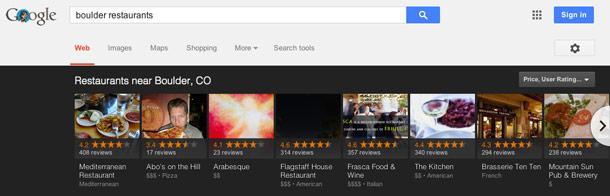
Local Carousel feature officially launched by Google back in June 2013, as an expansion of their already existing Knowledge Graph. The 2013 version of Google Carousel is shown in the image below.
Carousel provided the local searchers with an interactive display of results so they can quickly make an informed decision based on reviews, pictures, prices, and numerous other factors. Though it mostly affects searches related to local bars, restaurants, and hotels. With this new feature, as with any other new search feature, it is important for local businesses to optimize their listing so they don’t miss out on any opportunities to gain new customers.
The current Carousel, now often referred to as the “Local Stack” or “Local Pack” amongst industry professionals, has a white background and blends in more with the rest of the search engine result page. It also dramatically reduced the number of results shown, a “3-pack” in this instance. The updated version which is presently functional on Google search engine is shown in the image below.
Local SEO can get technical sometimes in its implementation, and hence, we have listed some quick tips that should be relatively easy for you to do for your business listing.
Quick Optimization Tips:
Create a Local Google Plus page for your business and connect it to your Local Places account (if applicable).
Fill in as much information as possible and available. This includes a proper profile image, selecting the proper business category, hours of operation, etc.
Upload images to your profile, and remember to upload the one you want to show up in the Local Carousel first.
Fill out the About section completely in the best possible way with a detailed overview of the business.
Add the website link.
And last but not least, link to your new profile on your website.
These steps should give you a great foundation for your local business listing in Google search results. After completing the steps and completion of the Google crawl over your page, search for your business and see how it looks. Based on the review of the page, you can keep it or make any necessary adjustments.
3. Voice Search
According to Google, one out of five search queries already come from voice to text functionality. New technology brings in more personal experiences, especially with developing the voice-to-text capability. It has changed the way of communication with the devices, making it easier and faster to process information.
A more significant shift towards voice search is expected in 2018, so it’s important to focus on optimizing more long tail keywords and natural language that facilitates the conversational tone used in talking. With improvements in the accuracy of voice technology and digital assistants, more people will make a move toward using it often.
Algorithms will keep getting smarter and changing as the method of search evolves.
Assessing the search engine requirements for ranking is critical to stay relevant and at the top of lists. Also due to the surge of smart home hubs like Alexa and Google Home penetrate more and more houses, voice search will integrate even further into consumers’ lives.
Growing opportunities to connect brand and user infiltrate today’s market, making it imperative that you improve your local SEO and content to take advantage of these unique and relevant statistics.
4. Put Mobile First
This year is going to be all about putting mobile first. Google plans to deploy a mobile-first index and this fact must be realized by the brands. Even without a mobile-first index, the majority of search terms comes from mobile devices and keywords rank differently on mobile than they do on a desktop computer.
The best possible visibility comes from local SEO marketing strategies geared toward mobile searches for your local businesses.
Mobile searches are most commonly based on context, and that includes location, making it a huge opportunity for brands to market locally.
Here local search SEO gains importance in terms of optimizing your page for such search queries. People on the go need fast answers, and optimizing your site for local searches on mobile generates relevance and increased chances of discovery.
A mobile-first strategy must take into account the voice searches by facilitating a search experience through personalized answers. Website speed is also critical, and you should consider accelerated mobile pages that load up to four times faster. Using a mobile device automatically implies urgency, and if you can’t compete, you’ll lose the battle.
Conclusion
Local SEO trends are important to keep your business from getting lost in the crowd. Irrespective of the fact that they change from year to year, these four trends are here to stay for the next few years to come.
So, no matter what you do, keep these four trends handy and see your business grow as the year moves on ahead.
Watch: 4 Local SEO Trends to Boost Your Business
For Curious Minds
Local SEO is a highly targeted discipline designed to increase your visibility to customers in your immediate geographic area. Its primary function is to place your business in front of a relevant audience precisely when they exhibit purchase intent through local search queries on platforms like Google.
Successfully implementing this strategy means optimizing your entire online presence to answer a user's location-based needs, which converts search traffic into foot traffic. A strong approach focuses on:
Claiming and verifying your Google My Business (GMB) profile to control your information.
Ensuring accuracy and consistency of your name, address, and phone number across all online directories.
Gathering positive customer reviews to build trust and authority.
The goal is to make your business the best possible result for a local search, ensuring you appear in the coveted “3-pack” and on Google Maps. Explore the full article to learn the tactics that make this possible.
The 'Local Pack' is the block of three business listings that appears at the top of the search results for local queries, representing Google's top recommendations. This feature evolved from the older Carousel to provide users with a faster, more decisive set of options, making it prime digital real estate for any local business.
Securing a spot in this “3-pack” is vital because it captures the majority of user attention and clicks. For industries like hospitality and food service, where customers make quick decisions based on proximity and reviews, appearing here is paramount. Optimization requires a focus on relevance, distance, and prominence, which are determined by factors like your GMB completeness, review quality, and website authority. Mastering the signals that Google values is the key to dominating these high-value results, a process detailed further in our complete guide.
The difference between passive and active Google My Business management is profound, directly impacting your visibility and customer perception. A passively claimed profile often contains outdated or incomplete information, while an actively managed one becomes a dynamic tool for customer acquisition and engagement.
An active management strategy delivers superior results by consistently signaling to Google that your business is relevant and operational. The key actions that differentiate this approach include regularly updating business hours, posting updates and offers, responding to customer reviews, and adding new photos. This sustained effort builds trust with both search engines and potential customers, leading to higher rankings in the Local Pack and more conversions. Discover how to transform your GMB profile from a static listing into a powerful marketing channel within the full article.
The 'Local Pack' directly reflects Google's core mission to deliver the best possible result quickly and efficiently. By limiting the initial display to just three businesses, the platform forces a high standard of quality, ensuring users see only the most relevant, reputable, and proximate options for their search query.
This format provides clear evidence that ranking is a competitive endeavor where only the most optimized businesses succeed. Businesses should infer that Google prioritizes a handful of critical signals, and mediocrity is not rewarded. Key takeaways from the “3-pack” structure include:
The necessity of a perfectly completed Google My Business profile.
The immense weight placed on the quantity and quality of customer reviews.
The importance of location data accuracy and a mobile-friendly website.
This competitive landscape means that ongoing optimization is not optional. The full article breaks down how to align your strategy with these critical ranking factors.
Neglecting a Google My Business profile after claiming it is a critical error that actively harms a business's online presence. This 'set it and forget it' approach often leads to outdated information, such as incorrect business hours or an old phone number, which creates a poor user experience and signals to Google that the listing is unreliable.
This directly causes a drop in local search rankings and can lead to lost sales when customers arrive at a closed store or call a disconnected number. In contrast, successful companies treat their GMB profile as a primary customer touchpoint. They implement a routine of monthly checks to confirm all information is accurate, respond to all new reviews within 24 hours, and use the Posts feature to share current promotions. This proactive management keeps the listing fresh, trustworthy, and positioned to rank highly in the Local Finder and on Google Maps. You can learn to build a similar process by reading our complete guide.
Achieving visibility in the Google 'Local Pack' requires a focused and systematic approach to optimizing your Google My Business profile. A contractor can establish a strong foundation by following a clear, three-step process designed to meet the search engine's criteria for relevance and trust.
This plan transforms your listing from a simple directory entry into a powerful lead-generation tool. The essential steps are:
Claim and Verify: Begin by searching for your business on Google Maps, then claim the listing and complete the verification process, which typically involves a postcard mailed to your physical address.
Complete Every Field:Fill out 100% of your profile, including services, service areas, accurate hours, photos of your work, and a detailed business description with relevant keywords.
Maintain and Engage: Regularly update your profile by responding to reviews, answering questions, and using GMB Posts to highlight projects or offers.
Executing these steps correctly is the first and most important part of any local SEO strategy. Dive deeper into each step and advanced tactics in the full article.
For a local retailer, an effective local SEO strategy begins with establishing a single source of truth for your business information online: your Google My Business profile. This is the most critical first step to ensure you appear correctly on Google Maps and in local search results when nearby customers are looking for products you sell.
The foundational setup should prioritize accuracy and completeness to build trust with Google's algorithm. Your initial focus should be on these key areas:
NAP Consistency: Ensure your business Name, Address, and Phone number are entered exactly as they appear elsewhere.
Primary Category: Select the most accurate and specific category for your store, as this is a primary ranking factor.
Business Hours: Enter precise opening and closing times, including special hours for holidays, to prevent customer frustration.
Getting these basics right is non-negotiable for capturing local search traffic. Learn about the next layer of optimizations you should tackle in the full article.
The transition to the 'Local Pack' signals that Google prioritizes quality over quantity, meaning a long-term local SEO strategy must be built on sustained effort and trust-building signals. Businesses can no longer rely on a one-time setup; they must now treat their local online presence as a continuous project to earn and maintain a top-three position.
Your strategy should shift from basic optimization to holistic reputation management. This means focusing on the elements that demonstrate your business is a prominent and trusted entity in your local area. Key long-term adjustments include actively soliciting reviews from happy customers, publishing location-specific content on your website, and ensuring your Google My Business listing is always a hub of fresh activity through posts and Q&A engagement. This sustained approach is what separates top performers from the rest, a topic explored further in our complete analysis.
The increasing sophistication of Google My Business profiles indicates a clear trend: Google aims to answer user queries directly on the search results page, reducing the need for clicks to a website. This implies that GMB is evolving into a 'mini-website' or primary storefront for local businesses, making its optimization more critical than ever.
In the future, your GMB listing may be the first and only interaction a customer has with your brand online. This means businesses must shift their mindset from viewing GMB as just a directory listing to treating it as a primary conversion tool. Features like direct messaging, quote requests, and service menus are turning these profiles into self-contained commerce platforms. As this trend continues, a meticulously managed GMB presence could become your most valuable digital asset. The full article explains how to prepare your business for this evolving landscape.
The most common and damaging mistake is abandoning the Google My Business profile after its initial verification, treating it as a static, one-time task. This 'set it and forget it' mentality allows information to become outdated and cedes a competitive advantage to more active businesses, leading to a slow decline in rankings and customer trust.
The solution is to implement a simple monthly audit. This process involves a checklist to ensure all information remains accurate and the profile stays active. Key actions should include:
Verifying that business hours, address, and phone number are correct.
Responding to all new customer reviews and questions.
Uploading at least one new photo of your business, products, or team.
Checking for and rejecting any incorrect user-suggested edits.
This routine takes very little time but sends powerful, positive signals to Google. Discover more ways to keep your listing competitive in our in-depth guide.
A poorly managed Google My Business profile is the primary cause of poor visibility on Google Maps and in the Local Finder. Google prioritizes listings that are complete, active, and accurate because they provide the best user experience; an incomplete or neglected profile is a strong negative signal that reduces your chances of being shown.
This lack of visibility is a direct result of missing or inconsistent information. To solve this, you must perform specific optimizations that build trust with the algorithm. These include selecting all relevant business categories (not just the primary one), defining a precise service area, consistently uploading geotagged photos, and actively encouraging and responding to customer reviews. These actions directly address the ranking factors for proximity, relevance, and prominence. The full article provides a detailed checklist for implementing these critical fixes.
A business can fail to attract nearby search customers when its digital footprint does not accurately reflect its physical presence. This disconnect happens when online information is inconsistent, incomplete, or untrustworthy, causing Google's algorithm to lack confidence in showing the business for relevant local queries, even if it is the closest option.
A fully optimized Google My Business profile solves this problem by acting as the authoritative hub for your location data. By ensuring absolute consistency in your name, address, and phone number, and by enriching the profile with photos, services, and positive reviews, you create a powerful, trustworthy signal. This aligns your digital and physical identities, making it easy for Google to connect your business to nearby searchers and confidently rank you in the Local Pack. Explore how to build this digital authority in the rest of our guide.
Amol has helped catalyse business growth with his strategic & data-driven methodologies. With a decade of experience in the field of marketing, he has donned multiple hats, from channel optimization, data analytics and creative brand positioning to growth engineering and sales.

 Growth Strategy and Planning