Contributors:
Amol Ghemud Published: September 18, 2023
Summary
What: A comprehensive comparison of Ahrefs and SEMrush, two leading SEO and digital marketing tools.
When: When you need to choose the right SEO platform for keyword research, backlink analysis, and site audits.
Why: To determine which tool offers better data accuracy, usability, and all-round value for your marketing goals.
How: By comparing their features, pricing, technical SEO, keyword tracking, and customer support.
In This Article
Share On:
Let’s compare Ahrefs and SEMrush, two rivals in the realm of SEO and digital marketing tools
Ahrefs
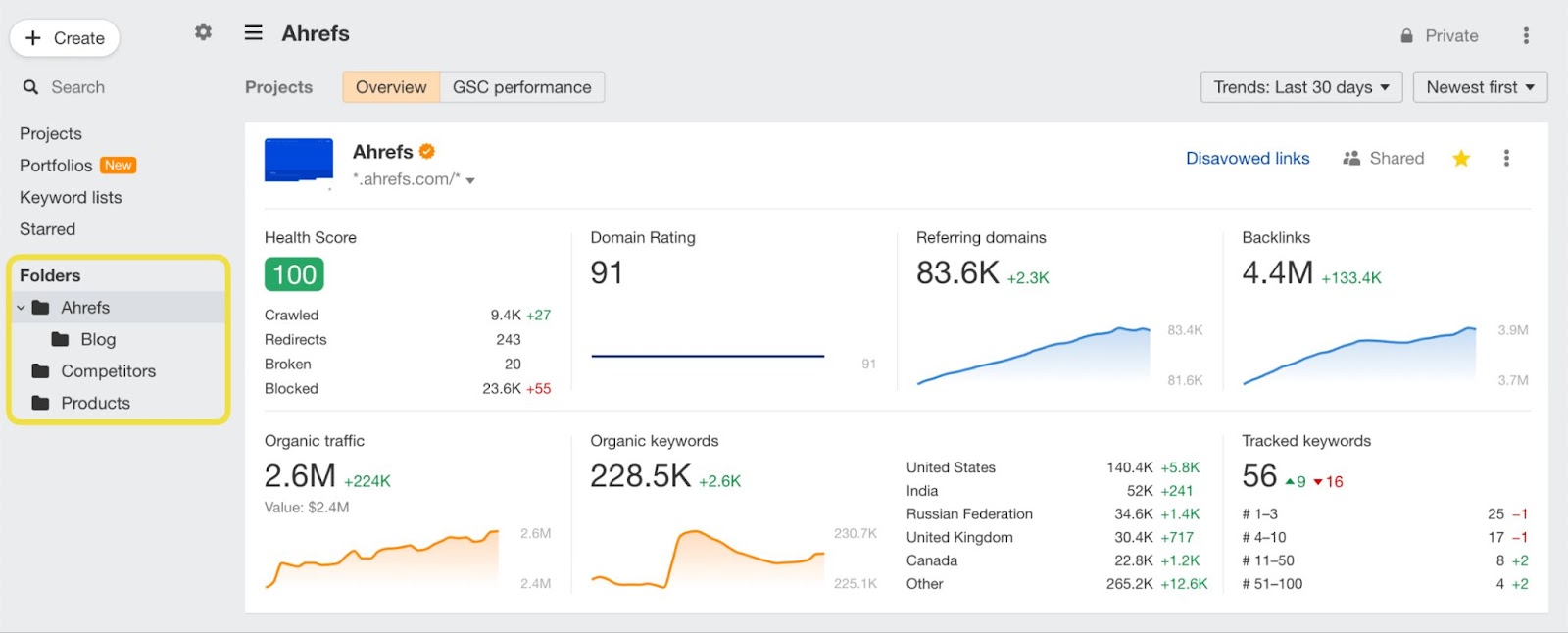
The Ahrefs Disavow Links tool can enhance the link profile and overall SEO health of a website. By utilizing this tool, users gain the ability to identify and eliminate detrimental or subpar backlinks. This results in improved website performance and visibility in search engine rankings
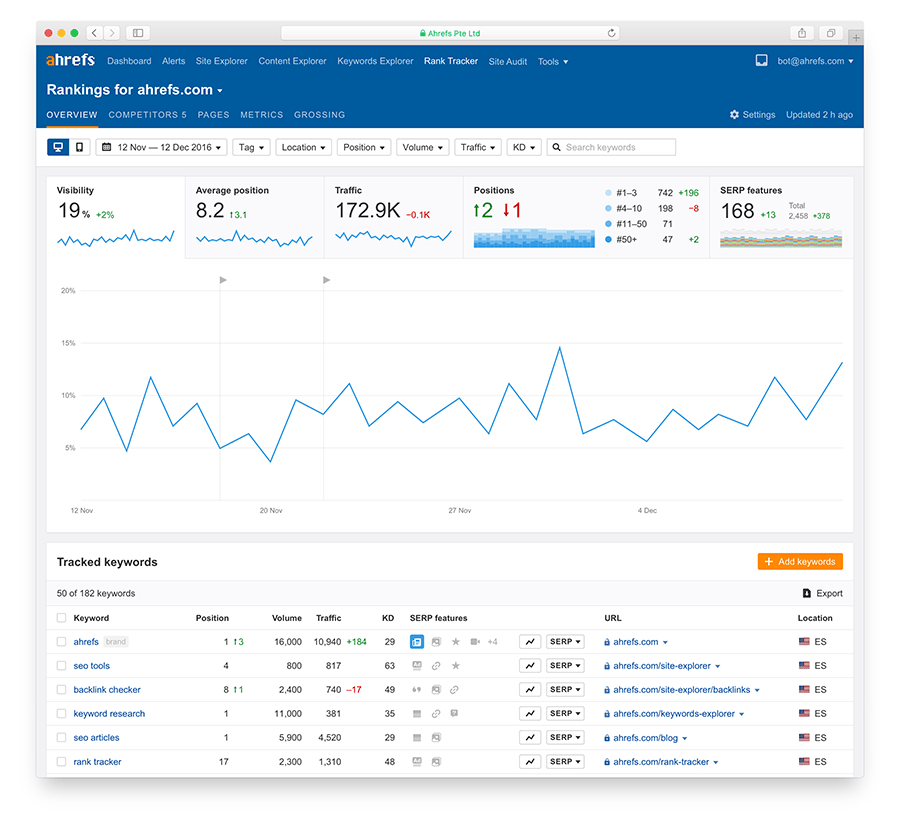
Ahrefs provides users with a valuable traffic checker tool, enabling them to analyze website traffic comprehensively. This tool offers insights into various aspects, including traffic sources, popular pages, and competitor analysis. It facilitates the assessment of a website’s performance and aids in content optimization.
A variety of pricing tiers are available through Ahrefs, including Lite, Standard, Advanced, and Agency. Each tier offers unique features along with specific usage restrictions. The determination of pricing primarily relies on factors such as the number of users and the required level of access.
SEMrush
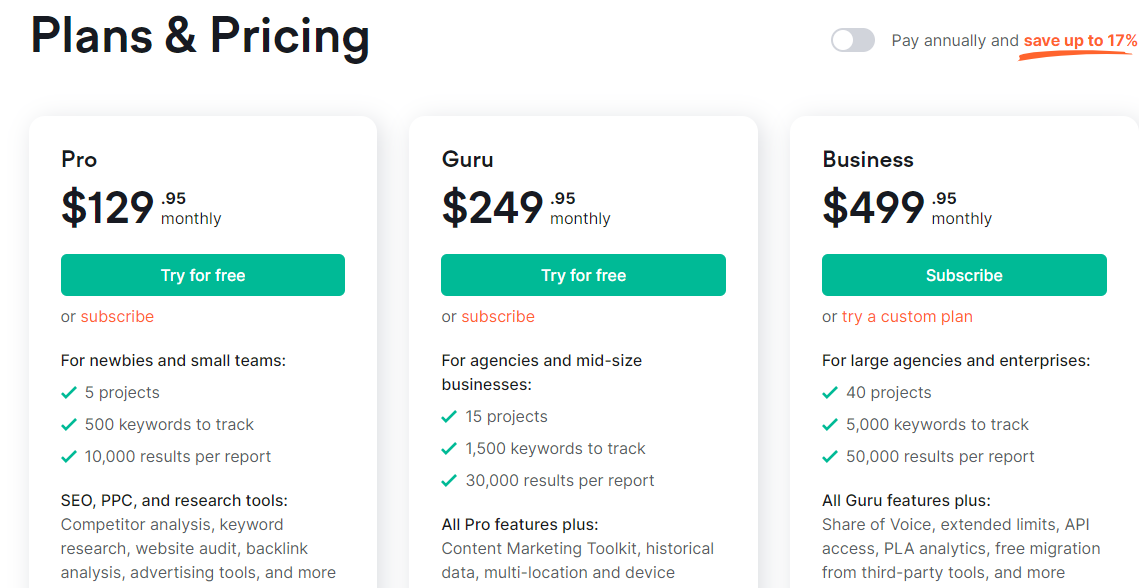
SEMrush provides several pricing options, including Pro, Guru, Business, and Enterprise. These options cater to different user needs based on the level of access they require to tools such as project management, competition analysis, and keyword research.
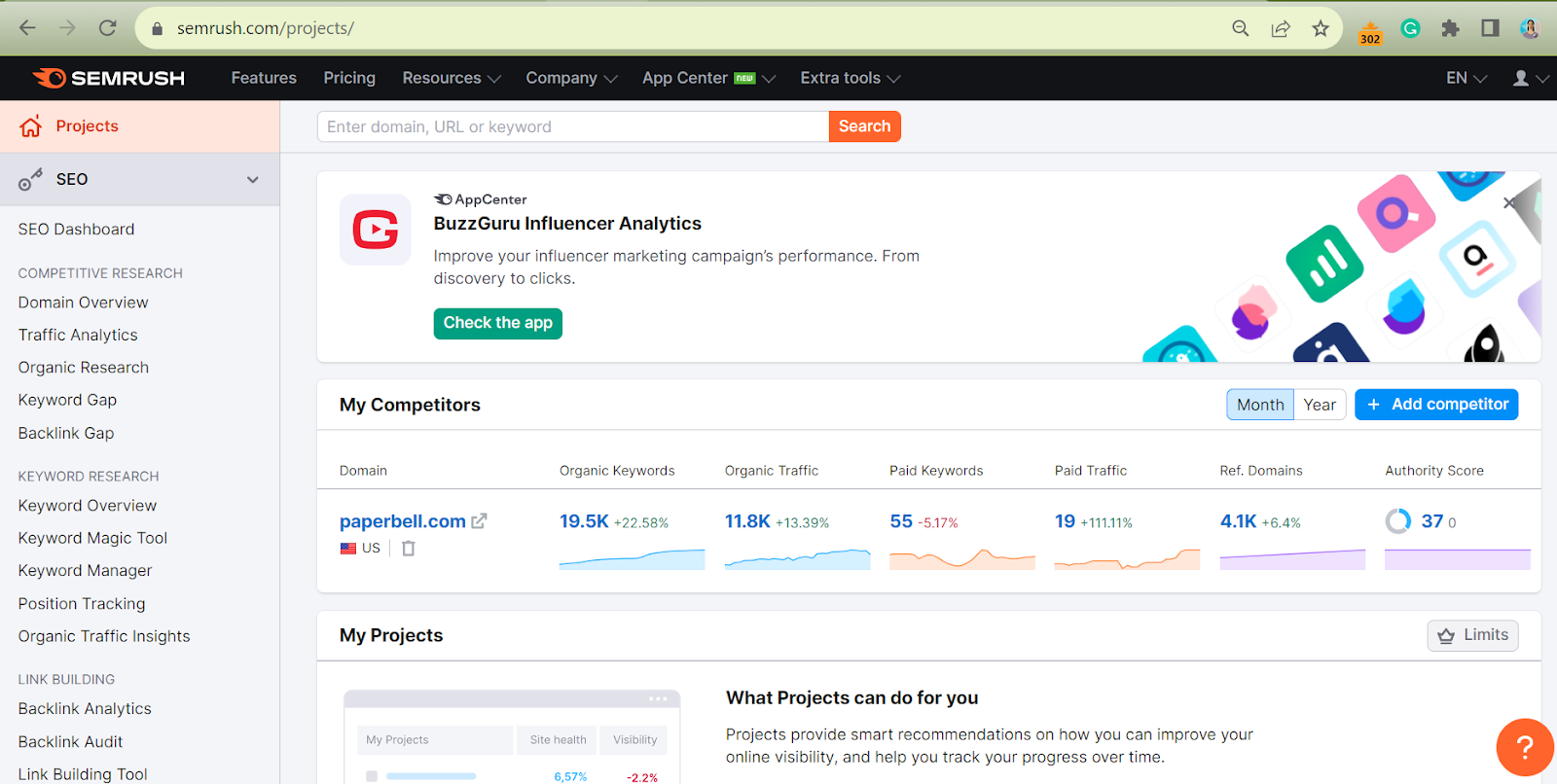
With the help of SEMrush’s traffic analytics tool, users can easily assess various website traffic statistics. This includes not only organic and sponsored search traffic, but also competitor performance and backlinks.
SEMrush offers comprehensive keyword research tools that allow users to discover relevant terms, evaluate keyword difficulty, and track keyword rankings. This is essential for optimizing content and improving SEO.
Which SEO keyword research tool is the best?
Ahrefs and SEMrush are both powerful SEO keyword research tools, each offering a range of options to suit different needs and preferences. Let’s compare them:
Ahrefs for SEO Keyword Research:
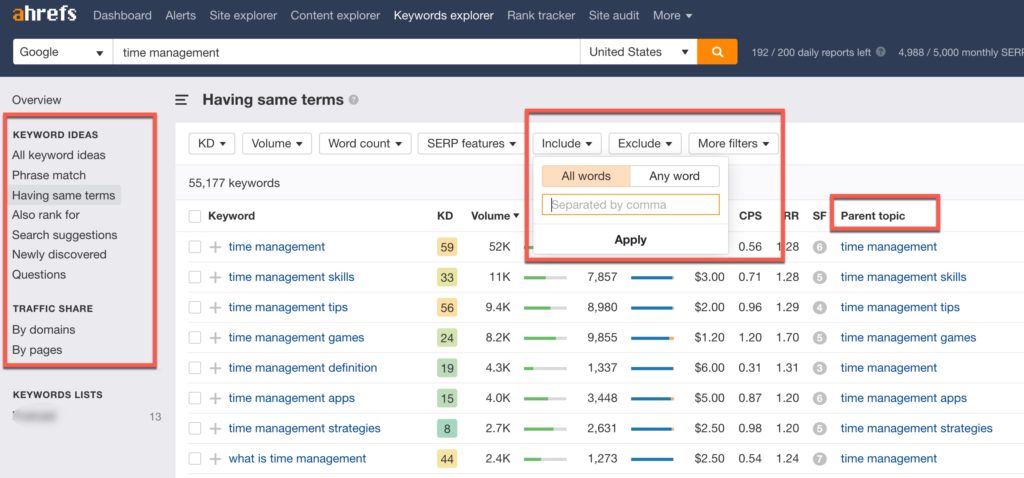
Ahrefs is a robust keyword research tool that offers valuable information for SEO purposes. It provides insightful data, including analysis of search engine results pages (SERPs), keyword search volume, and keyword difficulty.
If you need reliable and accurate keyword analytics, the Ahrefs Keyword Explorer tool is highly recommended. It has built a strong reputation for providing trustworthy results in identifying profitable keywords.
Additionally, it offers valuable insights into keyword competition, helping you identify opportunities and weaknesses in your SEO campaign.
Ahrefs is a powerful backlink analysis tool that can be incredibly valuable for keyword research. It not only helps in identifying potential link building opportunities but also provides comprehensive insights and data to support your SEO efforts.
SEMrush for SEO Keyword Research:
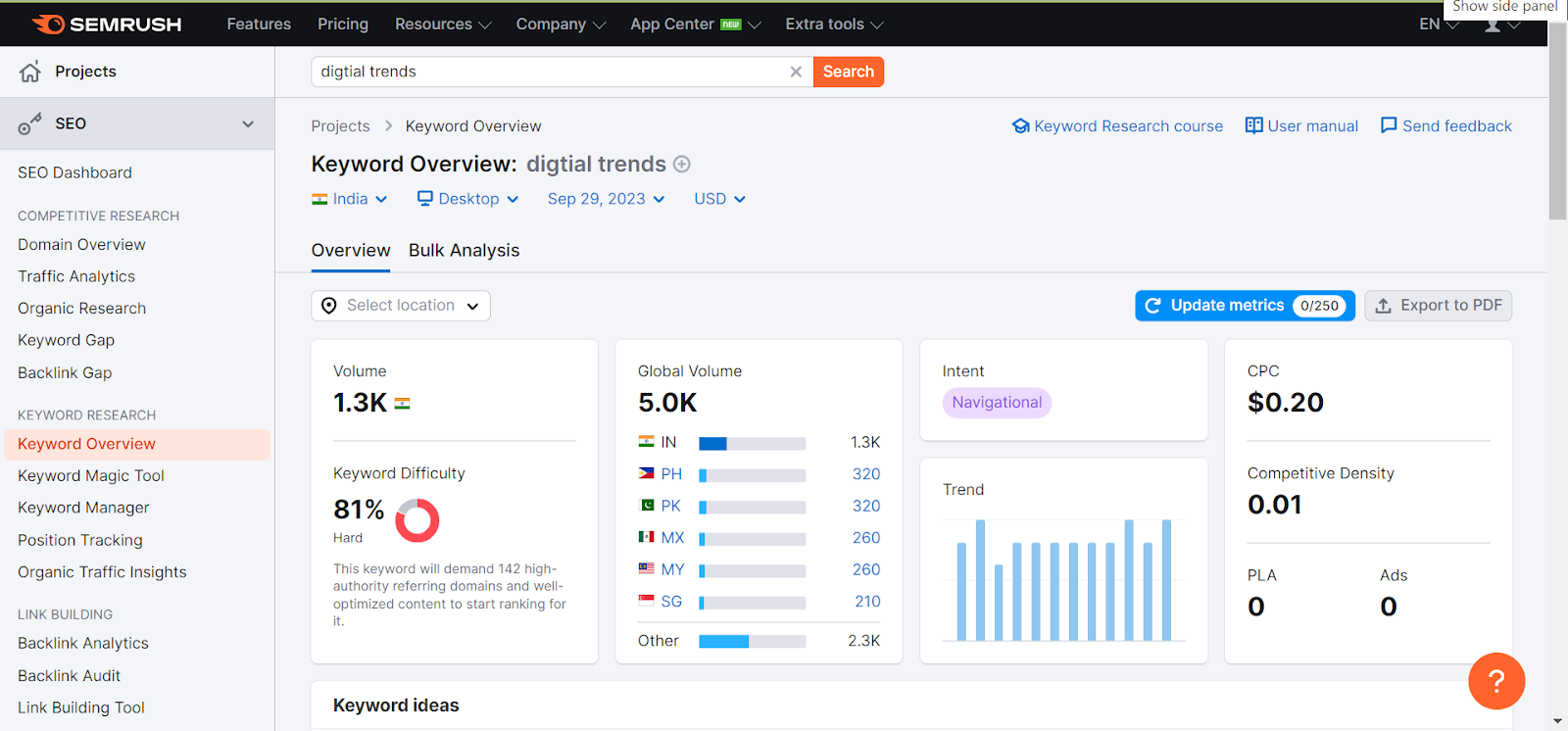
SEMrush is renowned for its exceptional keyword research capabilities, which include an extensive database of keywords, thorough keyword difficulty analysis, and comprehensive keyword trend statistics.
With the SEMrush Keyword Magic Tool, you can search for long-tail keywords, explore related keywords, and conduct thorough keyword analysis.
With SEMrush’s competitive analysis tools, you can uncover the keywords that your competitors are ranking for, allowing you to develop effective strategies accordingly.
It offers keyword suggestions that can help improve the visibility and ranking of your content in search engine results.
SEMrush has a user-friendly interface that is easy to navigate, and it seamlessly integrates with other digital marketing tools.
When using SEMrush, it’s important to keep in mind that they offer a wide range of SEO and digital marketing services beyond just keyword research.
Which Tool Is Best for Backlink Analysis?
Ahrefs is widely recognized as one of the leading tools in the market for backlink analysis. There are several key factors that contribute to Ahrefs’ standing as a top backlink analyzing tool:
Ahrefs for Backlink Analysis:
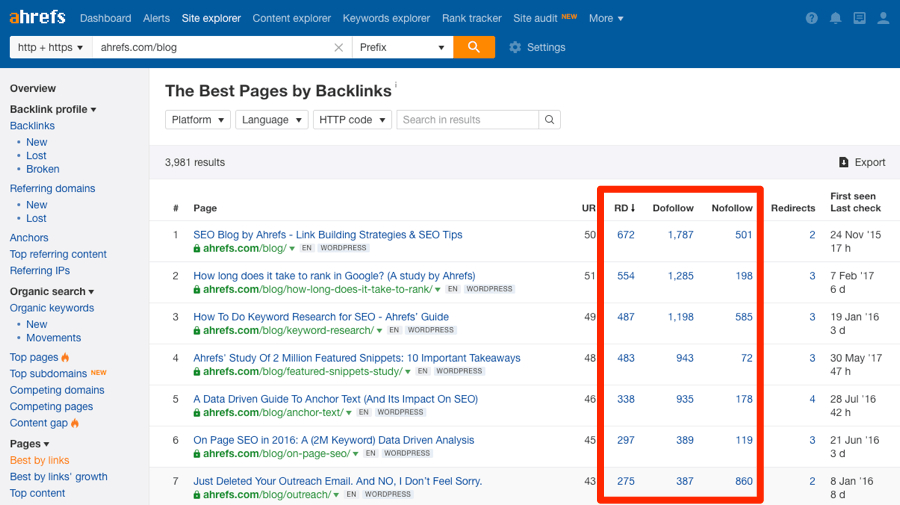
Widespread Backlink Database: Ahrefs has one of the most comprehensive and up-to-date backlink databases in the industry. Their continuous web search ensures complete coverage, allowing them to find and index new backlinks.
Backlink Profile Analysis: Analyzing a website’s backlink profile is made easy with Ahrefs. This tool provides comprehensive insights into the number of backlinks, referring domains, distribution of anchor text, and the authority of linked domains.
Competitor Analysis: When conducting competitor analysis, Ahrefs provides the valuable ability to analyze the backlink profiles of your competitors. This enables you to gain insights into their link-building strategies and identify potential opportunities for your own website.
Disavow Links Tool: A healthy backlink profile must be maintained, so Ahrefs provides a disavow tool that makes finding and removing spammy or poisonous backlinks easier.
Link Intersect Tool: You can find websites that connect to your competitors’ websites but not your own using the connect Intersect Tool. It helps you identify possible link-building candidates.
Historical Data: Ahrefs offers historical data on backlinks so you can keep tabs on changes to your backlink profile and gauge the effectiveness of your link-building activities over time.
Even though SEMrush is a flexible tool with many other digital marketing functions, Ahrefs excels at backlink research. Ahrefs is an excellent option if your main goal is to analyze and enhance your backlink profile. However, while choosing the best tool for your total digital marketing goals, it’s essential to consider the broader range of features and costs.
Which Tool Offers The Best Technical SEO Site Audit Functionality?
Digital marketers and SEO experts commonly prefer both Ahrefs and SEMrush for their reliable technical SEO site audit features. Your personal preferences and specific needs will ultimately determine which tool is the best fit for you.
Let’s compare the technical SEO site audit features of these two tools below:
A Site Audit Using Ahrefs for Technical SEO
Crawling and Indexing Analysis: Ahrefs offers insights into the way search engines crawl and index your website. It helps identify any issues, such as blocked pages or problems with crawling and indexability.
Analysis of On-Page SEO: The Ahrefs site audit tool analyzes important on-page SEO elements, including title tags, meta descriptions, header tags, and internal linking. It provides helpful recommendations for enhancing these components and optimizing your website for better performance.
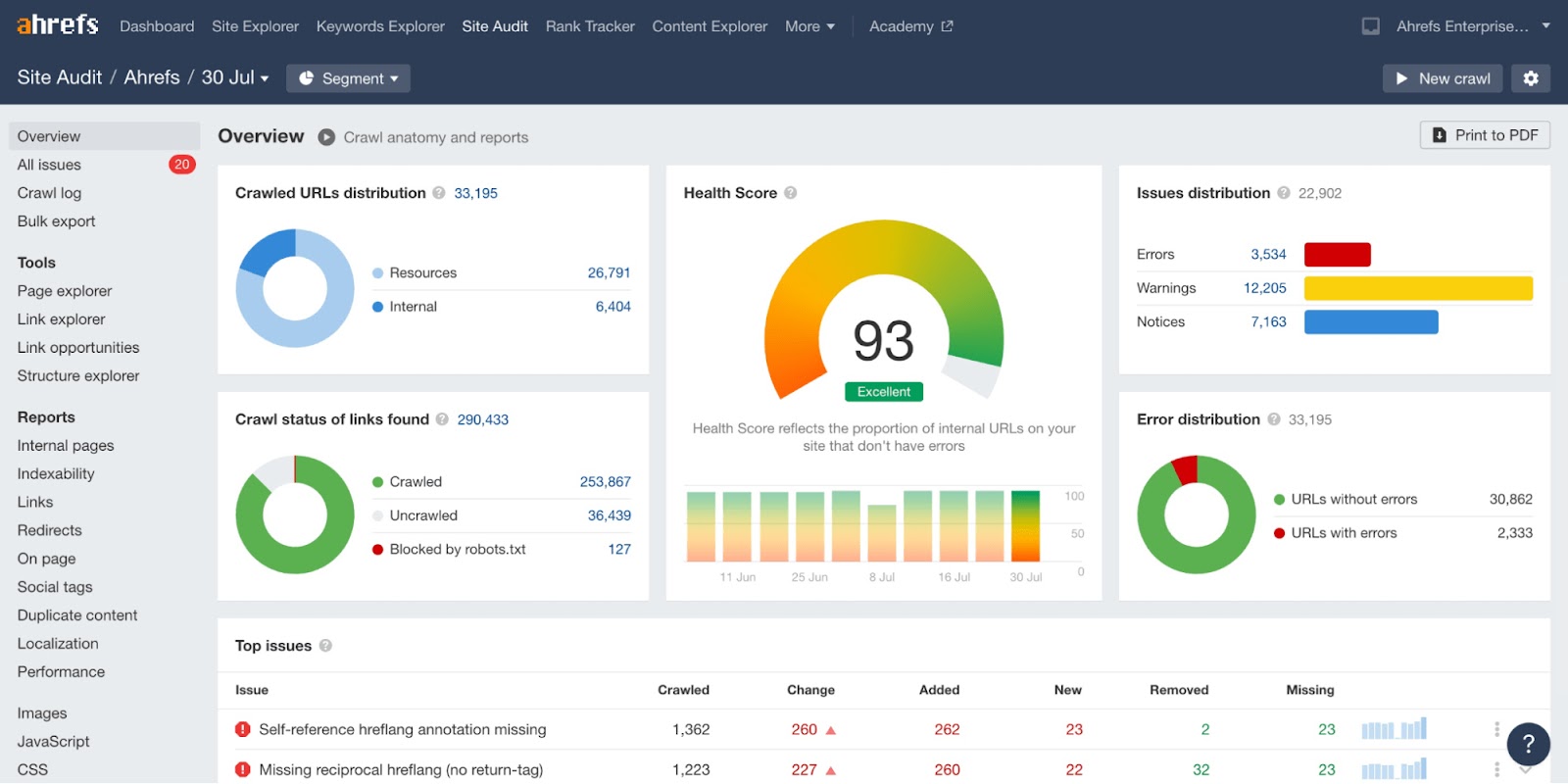
Site Health Monitoring: With Ahrefs, you can set up regular site audits to monitor the performance and condition of your website over time. This powerful tool tracks any issues and improvements, allowing you to measure the effectiveness of your SEO efforts.
Visual Representation: Ahrefs provides an intuitive display of audit results, making it easy to identify and prioritize issues.
Site Audit Using Technical SEO by SEMrush
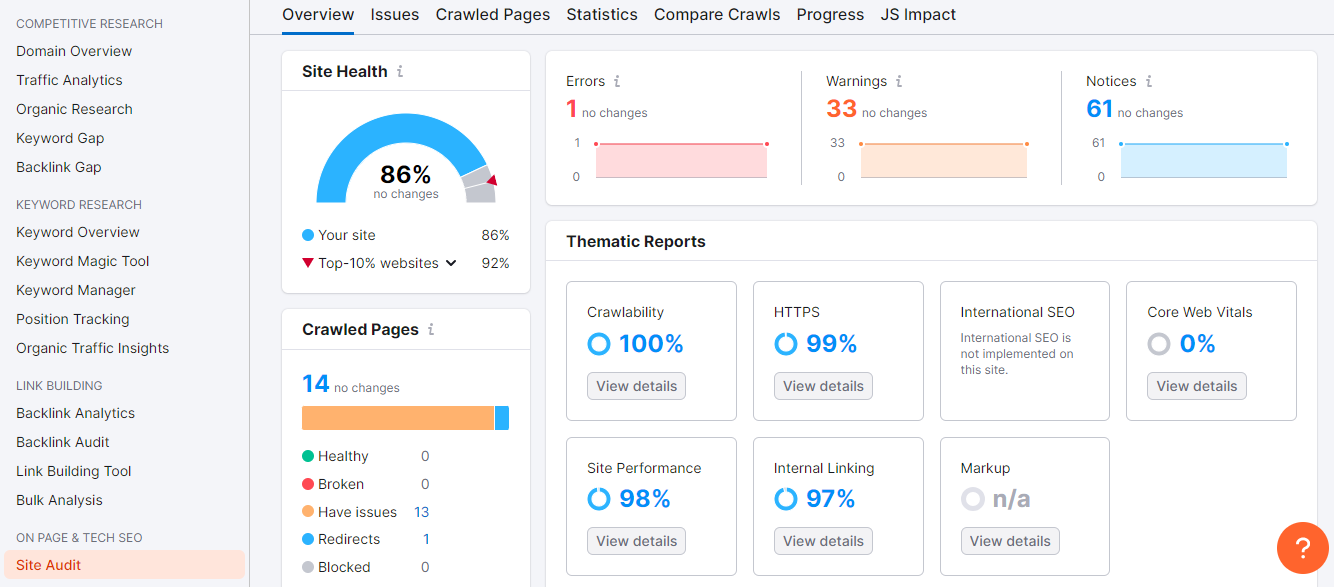
Detailed Technical SEO Audits: SEMrush offers comprehensive website audits that assess various aspects, including site speed, mobile compatibility, security, and more.
Crawl Depth and URL Structure Analysis: Get valuable insights on crawl depth, URL structure, and site architecture with SEMrush. These insights will help you enhance how search engines navigate through your website.
Structured Data Analysis: Analyzing structured data is an important part of SEMrush’s site audit feature. It helps identify and resolve issues related to rich snippets and schema markup on your website.
Integration with Google Search Console: SEMrush can integrate with Google Search Console, providing you with additional information and insights for your site audit.
Customizable Results: With SEMrush, you have the option to customize and brand your site audit results. This feature proves particularly valuable for businesses and agencies looking to deliver branded findings to their clients.
SEMrush and Ahrefs both excel in conducting technical SEO site audits. To determine which one is best for your specific needs, consider factors such as budget constraints and the specific features required for your digital marketing strategies. It’s recommended to test both products through demonstrations or trial versions to evaluate which one aligns better with your goals.
Which Tool Is Best for Rank Tracking?
Ahrefs and SEMrush are both reputable tools that offer extensive rank-tracking features. However, SEMrush is widely considered to be one of the top tools in this category. There are several reasons why SEMrush stands out as a great choice for rank tracking:
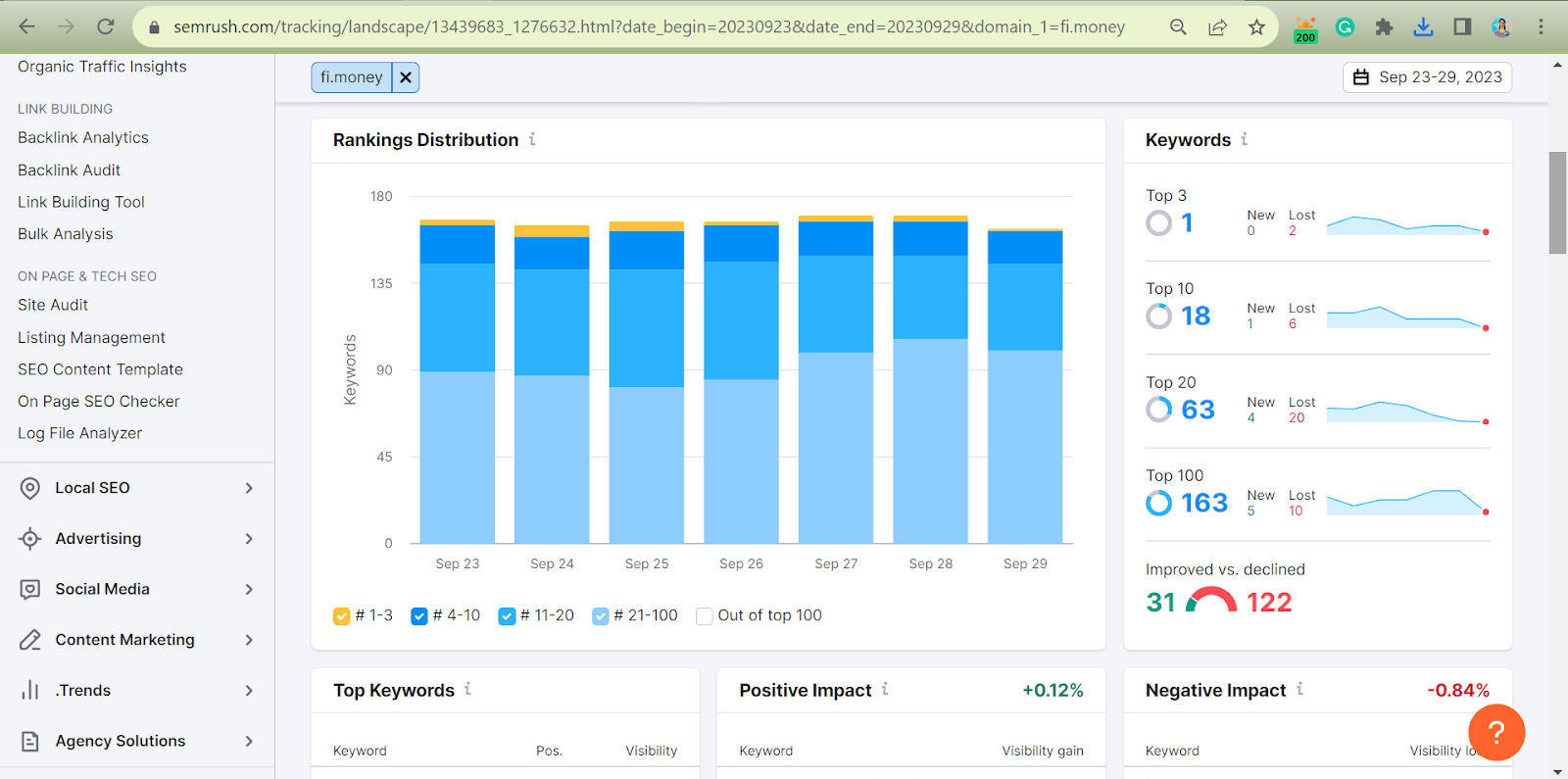
SEMrush provides comprehensive rank tracking features that allow you to monitor the rankings of your website for specific search terms on search engine results pages (SERPs).
SEMrush offers daily rank tracking updates, allowing you to stay updated on your rankings in real-time. This regular data update enables quicker responses and adjustments to any changes in your rankings.
SEMrush provides visualizations of keyword rank distribution, allowing to easily track the performance of your keywords across different search engine result positions. Analyzing your keyword rankings in comparison to your competitors can provide crucial insights into your performance and highlight areas where you have the potential for growth.
SEMrush maintains historical rankings data, allowing you to track trends and assess the effectiveness of your SEO campaigns as time goes on.
SEMrush offers features that allow businesses with local presence to track their rankings effectively. With the ability to monitor rankings for specific locations and target local keywords, businesses can optimize their online presence in their target markets.
With the increasing importance of mobile search, it is essential to ensure that your website is optimized for mobile devices. SEMrush offers a valuable feature that allows you to monitor keyword rankings specifically on mobile devices. This ensures that your site remains mobile-friendly and accessible to your target audience.
SEMrush’s rank tracking seamlessly integrates with other tools in the SEMrush suite, allowing users to benefit from features such as keyword research, competitive analysis, and site auditing.
While Ahrefs is a valuable SEO tool with many benefits, SEMrush surpasses it in terms of rank tracking capabilities, abundant features, and user-friendly design. This makes SEMrush the top choice for SEO experts and businesses seeking effective keyword rank monitoring and improvement.
Which Tool Has The Best Customer Support?
Both Ahrefs and SEMrush provide customer support, which can vary depending on your specific needs and situation. Here are the options for assistance offered by both tools:
Ahrefs Support
Knowledge Base: Ahrefs offers a comprehensive knowledge base that includes articles, tutorials, and guides covering a wide range of topics related to the capabilities and functionalities of their service. Users can find helpful solutions to common queries in this resource.
Email Support: Ahrefs provides support via email for users who encounter issues, have questions, or require assistance. Response times may vary based on the complexity of the inquiry and current support workload.
Blogging and Community: Ahrefs offers a blog and an interactive community forum. Users can engage with each other, ask questions, and share knowledge and experiences related to Ahrefs.
SEMrush Support
Knowledge Base: SEMrush provides a comprehensive knowledge base that offers tutorials, articles, and FAQs on a wide range of topics related to their tools.
Email Support: For users who need assistance or have questions, SEMrush provides email support. Although response times may vary, the team is committed to providing quick and helpful answers to users’ inquiries.
Live Chat: Need immediate assistance or have urgent concerns? SEMrush offers live chat support during business hours to provide real-time help to users.
Phone Support: SEMrush provides phone support to customers with specific subscription levels. This allows them to directly connect with the support staff and receive personalized assistance.
Webinars and Training: SEMrush offers a variety of resources to help users get the most out of their tool and stay updated on market trends. These include webinars, training sessions, and live demonstrations. By participating in these events, users can enhance their knowledge and optimize the value they derive from SEMrush.
SEMrush and Ahrefs both offer helpful support resources, but SEMrush stands out with its live chat and phone support services. These features can be especially beneficial for users seeking prompt assistance. Ultimately, the tool that offers the best support will depend on your preferences and specific needs.
Which Tool Offers The Best Value Overall?
The decision on whether Ahrefs or SEMrush provide the best overall value for your digital marketing needs depends on your specific requirements, budget limitations, and the range of services you require. Both tools offer effective solutions and have their own unique advantages. To help inform your decision, here is a comparison between the two:
Ahrefs
Ahrefs is known for its strong capabilities in link-building and backlink analysis. If your main focus is on competitor research, removing harmful links, and analyzing backlinks, Ahrefs may offer better value for you.
While Ahrefs provides tools such as site audit and keyword research, SEMrush offers a more comprehensive range of features.
Ahrefs offers multiple pricing options to cater to a wide range of consumers, from individual bloggers to small enterprises. This ensures affordability for everyone.
The lite plan of Ahrefs starts at $99/month, the standard plan starts at $199/month, the advanced plan starts at $399/month, and the enterprise plan starts at $999/month.
SEMrush
Its flexibility makes it an all-encompassing tool of digital marketing which covers everything, right from searching keywords, evaluating pages ranking, website evaluation, rival business analysis, website optimization through content, etc.
Since SEMrush offers so many features, it’s an excellent deal for companies or agencies seeking a product capable of handling all their digital marketing needs.
Since there are several pricing packages with different features available from SEMrush, users can choose one according to their distinctive requirements and costs. The plans and pricing of SEMrush start at $139.95/month for Pro plan, $249.95/month for Guru plan, and $499.95 for the Business plan.
In fact, what ultimately dictates which one of these tools will provide you with the “best all-round value” as an Ahrefs vs SEMrush comparison is largely dependent on your personal preferences. Its flexibility makes SEMrush potentially the most useful tool of all, given that it provides you with end-to-end SEO and overall digital marketing capabilities within one consolidated platform. Ahrefs could come in handy if your need is on the more specific side when it comes to backlink analysis and link building.
Conclusion
If link building is something you have come out seriously looking for, then Ahrefs could be the tool worth trying. However, if you require an agile, comprehensive digital marketing solution covering several SEO and digital marketing aspects, SEMrush might be more suited for you. Things like goals, budget, and features you’ll need for your marketing campaigns also matter. You can compare these features with a free trial or demonstration option before buying.
FAQs
1. What is the significance of choosing between Ahrefs and SEMrush for SEO in 2026?
Both tools remain industry leaders, offering robust features for SEO, content marketing, and competitor analysis. Your choice depends on specific needs, such as link building (Ahrefs) or broader marketing capabilities (SEMrush).
2. What are the key features that differentiate Ahrefs from SEMrush in 2026?
Ahrefs: Stronger in backlink analysis, content gap analysis, and domain authority metrics.
SEMrush: More versatile with tools for PPC, social media, and broader marketing tasks, along with in-depth SERP feature tracking.
3. How do the pricing structures of Ahrefs and SEMrush compare in 2026?
Ahrefs: Starts at $99/month; scalable for advanced plans up to $999/month.
SEMrush: Starts at $139.95/month; more expensive but includes broader marketing tools.
Annual billing offers discounts for both platforms.
4. Which tool is better for keyword research in 2026 – Ahrefs or SEMrush?
Ahrefs is better for long-tail keywords, search volume accuracy, and global metrics. While SEMrush is ideal for keyword grouping, SERP features, and competitive insights
5. Can I use Ahrefs and SEMrush together to complement each other’s features in 2026?
Yes, combining both tools can enhance your SEO strategy by leveraging Ahrefs for link analysis and SEMrush for broader marketing and keyword data.
6. How accurate and reliable is the data provided by Ahrefs and SEMrush in 2026?
Both tools provide highly accurate data, but differences can occur in metrics like backlink counts and keyword volume. Testing both can help identify which aligns better with your needs.
7. Which tool offers better competitor analysis capabilities in 2026 – Ahrefs or SEMrush?
Ahrefs excels in backlink comparison and domain authority. While SEMrush offers a more holistic view, including traffic trends, paid search, and social media.
8. Are there any training resources available for Ahrefs and SEMrush users in 2026?
Both platforms provide extensive resources, including webinars, blogs, YouTube tutorials, and certification courses. SEMrush offers more interactive training for marketers.
Watch: Ahrefs vs SEMrush — Which SEO Tool Comes Out Ahead?
A robust keyword research tool is the foundation of any successful content strategy, providing the data needed to align your content with user search intent. Using a platform like SEMrush helps you move beyond guesswork and build a data-driven plan to capture qualified traffic. An effective approach involves identifying primary and long-tail keywords that your audience uses, which is essential for creating relevant content that search engines will reward. To build a winning strategy, you should:
Discover relevant terms and long-tail variations with the Keyword Magic Tool.
Analyze keyword difficulty to find realistic ranking opportunities.
Track keyword rankings over time to measure performance and adjust your focus.
Evaluate keyword trend statistics to capitalize on emerging topics.
This methodical process ensures your content meets audience needs and directly challenges competitor rankings. To see a full breakdown of its capabilities, explore the detailed comparison in our guide.
A clean backlink profile signals to search engines that your website is a trustworthy and authoritative source, directly impacting its ability to rank. The Ahrefs Disavow Links tool is a critical component of technical SEO, allowing you to proactively manage your site's reputation by neutralizing harmful links. Maintaining a high-quality link profile is not a one-time task but an ongoing process of monitoring and curation. By eliminating toxic backlinks, you protect your site from potential penalties and strengthen its overall SEO foundation. This tool helps improve your site's health by enabling you to identify detrimental or subpar backlinks from spammy domains, submit a disavow file to Google, and ultimately enhance your website's performance and search visibility. Exploring how this feature fits into a broader SEO toolkit is a key focus of the complete analysis.
For a small business, the choice between Ahrefs and SEMrush often comes down to balancing advanced features with budget constraints. Both platforms offer powerful keyword research tools, but their entry-level plans are structured differently to cater to distinct needs. SEMrush often provides a broader suite of marketing tools in its initial tiers, while Ahrefs is celebrated for the depth and accuracy of its backlink and keyword data. When evaluating their introductory plans, consider these factors:
SEMrush Pro: Offers a comprehensive toolkit including keyword research, competition analysis, and project management tools, making it a strong all-in-one option.
Ahrefs Lite: Delivers highly accurate keyword and backlink data via its Keyword Explorer but has tighter usage restrictions that may be a consideration.
User Interface: SEMrush is known for a more user-friendly and navigable interface, which can be beneficial for smaller teams without dedicated SEO experts.
The best fit depends on whether your priority is an all-in-one marketing platform or best-in-class core SEO data. The full article provides a deeper comparison of their features at each price point.
Ahrefs has built its reputation on having one of the most extensive and frequently updated backlink indexes in the industry, which gives it a distinct advantage. Its power lies in the granularity of its data and the tools it provides to analyze and act on that information. The platform excels at not just showing you who links to a site, but also the quality and context of those links. This allows you to replicate competitor successes and discover untapped opportunities. Key features that distinguish its backlink analysis include:
A massive index of live backlinks, providing a comprehensive view of any domain's link profile.
Detailed SERP analysis to understand the top-ranking pages for target keywords.
The ability to identify and track new, lost, and broken backlinks for your site and competitors.
Advanced filters to sort link opportunities by domain rating, traffic, and link type.
These capabilities make it invaluable for building a data-informed link-building campaign. Our complete guide examines how to use these features for maximum impact.
The SEMrush Keyword Magic Tool is a central feature that empowers marketers to move beyond broad, highly competitive head terms and uncover valuable long-tail keywords. This tool organizes a massive database of keywords into topic-specific groups, making it simple to find relevant, low-competition phrases. The strategic advantage comes from its ability to reveal user intent at scale, allowing you to create content that precisely answers specific audience questions. By focusing on these niche queries, you can attract highly qualified traffic with a greater likelihood of conversion. The tool provides a wealth of data points for each keyword, including search volume, keyword difficulty, trend statistics, and related questions, all of which are essential for making informed content decisions. Understanding how to interpret this data is key to unlocking its full potential, a topic covered in the main article.
While both Ahrefs and SEMrush offer robust traffic analysis, they provide distinct perspectives that a digital agency can use for comprehensive client strategies. Ahrefs's traffic checker excels at providing deep insights into organic search traffic and the specific pages that drive it. SEMrush's traffic analytics offers a broader view, incorporating data on paid search, referral, and direct traffic sources for a more complete picture of a competitor's digital footprint. An agency might use Ahrefs to reverse-engineer a competitor's most successful organic content, while using SEMrush to understand their overall marketing mix and budget allocation. Together, they allow an agency to identify a competitor's weaknesses, such as over-reliance on paid ads, and develop a client strategy to exploit those gaps with strong organic content. The full comparison details how to integrate insights from both tools for superior results.
Using SEMrush's competitive analysis tools, a marketing team can systematically uncover and target a competitor's most valuable keywords to inform their own SEO strategy. This data-driven approach removes speculation and focuses efforts on proven ranking opportunities. The goal is to identify 'keyword gaps' where competitors are ranking but your site is not, presenting a clear path for content creation. A practical, stepwise plan involves:
Identify Competitors: Start by entering your domain into SEMrush to identify your main organic search competitors.
Analyze Keyword Profiles: Use the Organic Research tool to see all the keywords a competitor ranks for, along with their search volume and traffic contribution.
Find Keyword Gaps: Use the Keyword Gap tool to compare your domain against several competitors simultaneously, revealing keywords they rank for that you are missing.
Prioritize Opportunities: Filter the keyword gap list by keyword difficulty and search volume to find high-impact, achievable targets for your new content.
Following this process creates a clear roadmap for content development. Our guide offers more advanced techniques for leveraging this competitive data.
As search algorithms evolve to better measure trust and authority, the role of backlink analysis tools like Ahrefs will shift from a simple link-counting exercise to a sophisticated qualitative assessment. In the future, competitive SEO will be less about the quantity of backlinks and more about their quality, relevance, and the authority they confer. The winning strategy will involve earning links from topically relevant, high-authority domains, a task that requires deep competitive intelligence. Tools such as Ahrefs will become indispensable for mapping out competitor link profiles, identifying authoritative sites in a niche, and discovering content formats that naturally attract high-quality links. This means SEO professionals must focus on building relationships and creating link-worthy assets, using data from these platforms to guide their efforts toward what is proven to work. The full analysis explores emerging trends in link building.
Many websites inadvertently accumulate toxic backlinks through negative SEO or by associating with low-quality directories, which can suppress rankings and risk manual penalties from search engines. The Ahrefs Disavow Links tool provides a direct solution by empowering webmasters to identify and neutralize these threats before they cause significant damage. Instead of reacting to a penalty, a proactive approach involves regular backlink audits to maintain a clean and authoritative profile. This process ensures that your SEO efforts are not undermined by harmful external factors. By using the tool to regularly monitor your link profile, you can spot and disavow spammy or subpar links as they appear, thereby protecting your site's health and preserving its hard-earned authority in search engine results pages. The complete article explains when and how to use this tool effectively.
A frequent challenge in content strategy is finding the sweet spot between high-volume keywords that attract traffic and low-competition terms that are realistically attainable to rank for. The Ahrefs Keyword Explorer directly addresses this problem by providing a highly reliable keyword difficulty score. This metric goes beyond simple volume, estimating how hard it will be to rank on the first page of Google based on the backlink profiles of the current top-ranking pages. This allows content creators to make informed decisions and prioritize their efforts effectively. The tool helps solve this problem by:
Assigning a numerical difficulty score (0-100) to every keyword.
Showing the estimated number of backlinks needed to rank in the top 10.
Providing a SERP overview to manually assess the strength of the competition.
By using this data, you can build a content plan targeting keywords that offer the best return on investment. The full guide offers a closer look at how to interpret these metrics.
A B2B content strategist can use SEMrush to build a powerful topic cluster model, a structure that signals expertise to search engines and systematically improves rankings for core services. This model involves creating a central 'pillar' page for a broad topic and surrounding it with 'cluster' content that addresses related subtopics in detail. SEMrush's keyword tools are perfect for this, helping you map out both the pillar and cluster topics based on real search data. The Keyword Magic Tool can be used to identify a broad pillar topic, then its grouping features help uncover related long-tail keywords and questions that form the basis of your cluster articles. By interlinking this content, you create a web of relevance that boosts the authority of your main service pages and improves overall site visibility. Our complete analysis provides further detail on executing this advanced content strategy.
For large agencies, the choice between high-tier plans from Ahrefs and SEMrush depends heavily on workflow, reporting needs, and team structure. The Ahrefs Agency plan is built around its core strength of deep SEO data, offering extensive usage limits for tracking keywords and analyzing backlinks across many client projects. SEMrush, with its Business and Enterprise plans, offers a more integrated marketing suite with robust project management features, white-label reporting, and API access, which can be critical for agencies that provide a wider range of digital marketing services. Key differences for an agency to consider include:
Project Management: SEMrush provides more built-in tools for managing distinct client projects and campaigns.
Reporting: SEMrush offers more advanced, customizable, and white-label reporting options suitable for client-facing presentations.
User Access: Both provide multi-user access, but the specific limits and permissions differ, which can affect team collaboration.
Ultimately, an agency focused purely on SEO might prefer Ahrefs, while one offering a full suite of services may find SEMrush a better fit. The full article compares these plans in greater detail.
Amol has helped catalyse business growth with his strategic & data-driven methodologies. With a decade of experience in the field of marketing, he has donned multiple hats, from channel optimization, data analytics and creative brand positioning to growth engineering and sales.

 Growth Strategy and Planning